Vera Clarissa
The intersection of classic optical physics and modern digital manipulation has recently yielded a unique aesthetic exploration, demonstrating how rudimentary equipment—specifically an aging iPhone 3Gs and a standard color diffraction grating—can be leveraged to create complex visual compositions. What began as a purely empirical inquiry into light spectrums has evolved into a structured photographic project, highlighting the potential for high-quality creative output from low-end hardware. This initiative serves as a case study for how hobbyist experimentation, when combined with deliberate post-production techniques, can bridge the gap between simple light refraction and professional-grade graphic design.
The Physics of Light Diffraction
To understand the underlying mechanics of this project, one must consider the role of the diffraction grating. A diffraction grating is an optical component with a periodic structure that splits and diffracts light into several beams traveling in different directions. The color of these beams is dictated by the wavelength of the incident light, effectively acting as a prism to separate white light into its constituent spectral colors.

In the initial phases of the experiment, a diffraction grating was applied to the camera lens of an iPhone 3Gs. This device, while considered obsolete by contemporary mobile standards, provides a sufficient sensor for capturing the primary visual data required for light-based experiments. The process relies on the interference pattern generated by the grating, which organizes scattered light into predictable, aesthetically pleasing spectrums. Unlike modern computational photography, which often uses software to simulate optical effects, this approach utilizes physical refraction to generate the raw assets before any digital intervention occurs.
Chronology of the Experimental Process
The project followed a multi-stage progression, beginning with outdoor sunlight testing. Initial attempts to capture the sun’s spectrum provided a baseline for how different light sources react to the diffraction filter. While sunlight offered a broad spectrum, the intensity and ambient light pollution in an uncontrolled outdoor environment proved less than ideal for the intended artistic outcome.
The transition to controlled indoor environments marked a significant shift in the methodology. By moving away from natural light, the experimenter gained the ability to manipulate the angle of incidence—the angle at which the light hits the grating—and the distance between the source and the sensor. A yellow halogen light was selected as the secondary subject, known for its "full" and radiant output. The resulting imagery from this stage was sufficiently compelling that it was adopted as a desktop wallpaper for the Low End Mac community, demonstrating the practical application of the experimental process.

The final phase focused on the LED flashlight. Unlike the halogen bulb, the LED provided a more concentrated, directional beam. By darkening the room entirely, the experimenter eliminated secondary light contamination, allowing the diffraction grating to isolate the light into a singular, "comet-like" streak. This controlled environment was critical, as it allowed for the stabilization of the "light bead" against a black backdrop, facilitating easier digital processing later.
Technical Methodology and Post-Production
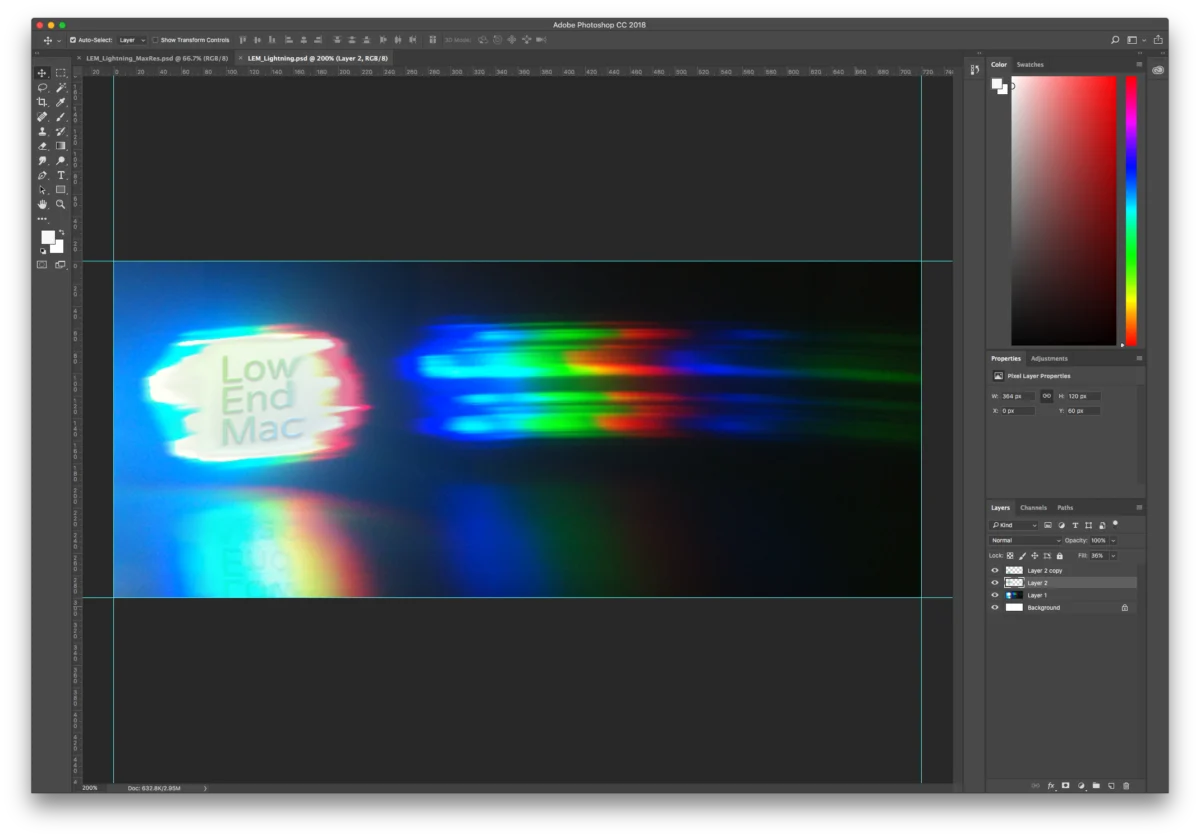
The transition from raw photograph to finalized art piece is conducted entirely within Adobe Photoshop, adhering to a philosophy of minimal modification. The technical workflow follows a precise sequence:
- Isolation: The primary light orb is cleared of peripheral light interference, creating a "blank" canvas within the light source itself.
- Graphic Integration: A logo—specifically the Low End Mac insignia—is inserted into the void of the light orb.
- Spatial Alignment: The logo is skewed to match the trajectory and angle of the light streak, ensuring visual continuity between the light and the graphic element.
- Smudging and Blending: The edges of the logo are processed using digital smudging tools to replicate the natural distortion and streaks inherent in the diffraction-filtered light.
- Reflective Modeling: A mirrored version of the logo is placed at a low opacity (approximately 10%) beneath the primary image to simulate a reflective surface, adding depth and three-dimensionality.
- Background Correction: A gradient overlay, transitioning from transparent to solid black, is applied to the entire composition to eliminate any remaining artifacts from the room’s background, ensuring a clean, high-contrast final product.
Comparative Analysis of Light Sources
Data collected throughout these experiments reveals significant variance in spectral output between light sources. The halogen source, characterized by a continuous spectrum, produced warmer tones and a wider dispersion of colors. In contrast, the LED flashlight, which relies on electroluminescence, produced a sharper, more defined spectrum with higher color saturation in the blue and violet ranges.

The following table summarizes the spectral characteristics observed:
| Light Source | Spectral Type | Diffraction Performance | Aesthetic Utility |
|---|---|---|---|
| Sunlight | Continuous | Highly variable; requires ND filters | High environmental glare |
| Halogen | Thermal Radiation | Full, warm spectrum | Excellent for textures |
| LED | Electroluminescence | Sharp, crisp streaks | Ideal for graphic layering |
These observations suggest that the choice of light source is the most critical variable in determining the final artistic output. The LED, while less "natural" in its color rendering than a halogen bulb, provides the cleanest baseline for digital manipulation, as it does not produce the same level of spectral noise.
Broader Implications for Digital Media
The success of this project suggests a broader trend in the digital art community: the "re-purposing" of legacy hardware for creative innovation. As mobile devices are upgraded at increasingly rapid cycles, the utility of older hardware often ends at the recycling bin. Projects of this nature, however, prove that even a 2009-era sensor can provide sufficient fidelity for professional-level artistic production when paired with specific, inexpensive physical attachments.

Furthermore, this experiment serves as a reminder of the importance of foundational physics in an era of AI-generated imagery. While modern software can generate light effects with a single prompt, there is a distinct, verifiable quality to imagery that begins as a physical interaction with light. The process of capturing a "real" photon as it bends through a diffraction grating, and then treating it with the care of a digital artisan, creates an authenticity that is often absent in purely synthetic media.
Expert Reaction and Future Potential
Photographic analysts note that the technique of using diffraction gratings in amateur photography—often referred to as "spectroscopic art"—has seen a minor resurgence. By using a smartphone as a digital back for what is effectively a simple spectrometer, creators are exploring the "hidden" characteristics of household lighting.
"What we are seeing here is the democratization of optical experimentation," says one industry observer familiar with the project. "The technical hurdle of using a diffraction grating is low, but the artistic ceiling is incredibly high. When you combine that with the accessibility of modern post-processing, you empower the user to create visuals that would have required a professional optical laboratory just a few decades ago."

Future iterations of this experiment could involve the use of more sophisticated diffraction gratings, such as holographic or blazed gratings, which could yield even more precise color separation. Additionally, the application of this technique to high-speed photography could reveal how light streaks fluctuate in real-time, providing an even deeper look into the behavior of different light sources.
Conclusion
The evolution of this project from a casual experiment with an iPhone 3Gs to a refined graphic design workflow illustrates the intersection of curiosity, hardware limitations, and creative discipline. By stripping away unnecessary complexity and focusing on the raw properties of light, the project achieves a sophisticated aesthetic that belies the simplicity of the equipment used. As digital media continues to favor high-fidelity, high-complexity imagery, there remains a significant space for these "low-end" approaches that prioritize the physics of light over the raw power of the processor. Through this lens, the humble LED flashlight and a piece of diffraction film become more than just office supplies; they become tools for redefining the visual identity of digital publications.