Arya Paningal
Since its founding in 2017 as a specialized sub-brand of Robotime, ROKR has carved out a unique niche in the hobbyist market by bridging the gap between traditional architectural model kits and functional mechanical engineering. By utilizing laser-cut wood and high-precision components, the company has transformed the concept of the "build-at-home" model from static display pieces into interactive, kinetic experiences. Their latest release, the Dinosaur Lab 3D Pinball machine, represents a significant evolution in their product design philosophy, shifting from the rustic, wooden aesthetics of their inaugural 3D Pinball Puzzle to a more robust, integrated, and thematic gaming system.

The Evolution of ROKR Mechanical Kits
The journey toward the Dinosaur Lab began years ago with the company’s exploration of "Marble Run" construction sets. These kits, priced competitively between $40 and $65, established a foundational consumer base interested in the mechanics of gravity, kinetic energy, and structural assembly. The success of these early kits provided the necessary research and development capital to venture into the complex world of tabletop pinball.

The original 3D Pinball Puzzle, released three years prior, served as a proof-of-concept for the brand. That model featured 482 individual pieces, including wooden ramps and ball guides, requiring approximately twelve hours of assembly time. It introduced consumers to the integration of computer-controlled lighting, opto-sensors, and rudimentary electronic scoring—a massive leap forward for a self-assembly wooden kit. With the release of Dinosaur Lab, ROKR has sought to refine these elements, addressing feedback from the enthusiast community regarding gameplay depth and structural durability.

Chronology of the Dinosaur Lab Project
The path to the market for the Dinosaur Lab was marked by a strategic reliance on crowdfunding to validate demand. The project officially launched on the Kickstarter platform on June 1, 2026. This move followed a established company pattern, as ROKR had previously utilized the platform for three successful campaigns between December 2022 and August 2024.

The project’s fiscal performance was robust, indicating sustained interest in high-end mechanical puzzles. Early bird backers secured units for approximately $65, with the price scaling incrementally as supply tiers were exhausted. By the time the campaign concluded on July 9, 2026, the project had exceeded its initial funding goal by a factor of eighteen, supported by over 4,000 individual backers. Following the close of the campaign, the production phase underwent a slight delay as the company optimized the kit’s final components for mass distribution. While original estimates projected a swifter turnaround, the two-month extension allowed the manufacturer to ensure that the complex opto-sensors and lighting strips met quality assurance standards before global shipping commenced in late 2026.

Design Philosophy and Aesthetic Shifts
A primary point of interest for long-term ROKR collectors is the marked shift in the visual language of the Dinosaur Lab. While the predecessor favored a natural, light-wood finish that emphasized the organic nature of the assembly, the Dinosaur Lab adopts a darker, more industrial, and plastic-heavy aesthetic. This transition is not merely cosmetic; it reflects an engineering requirement to support more intricate 3D models and tighter build tolerances.

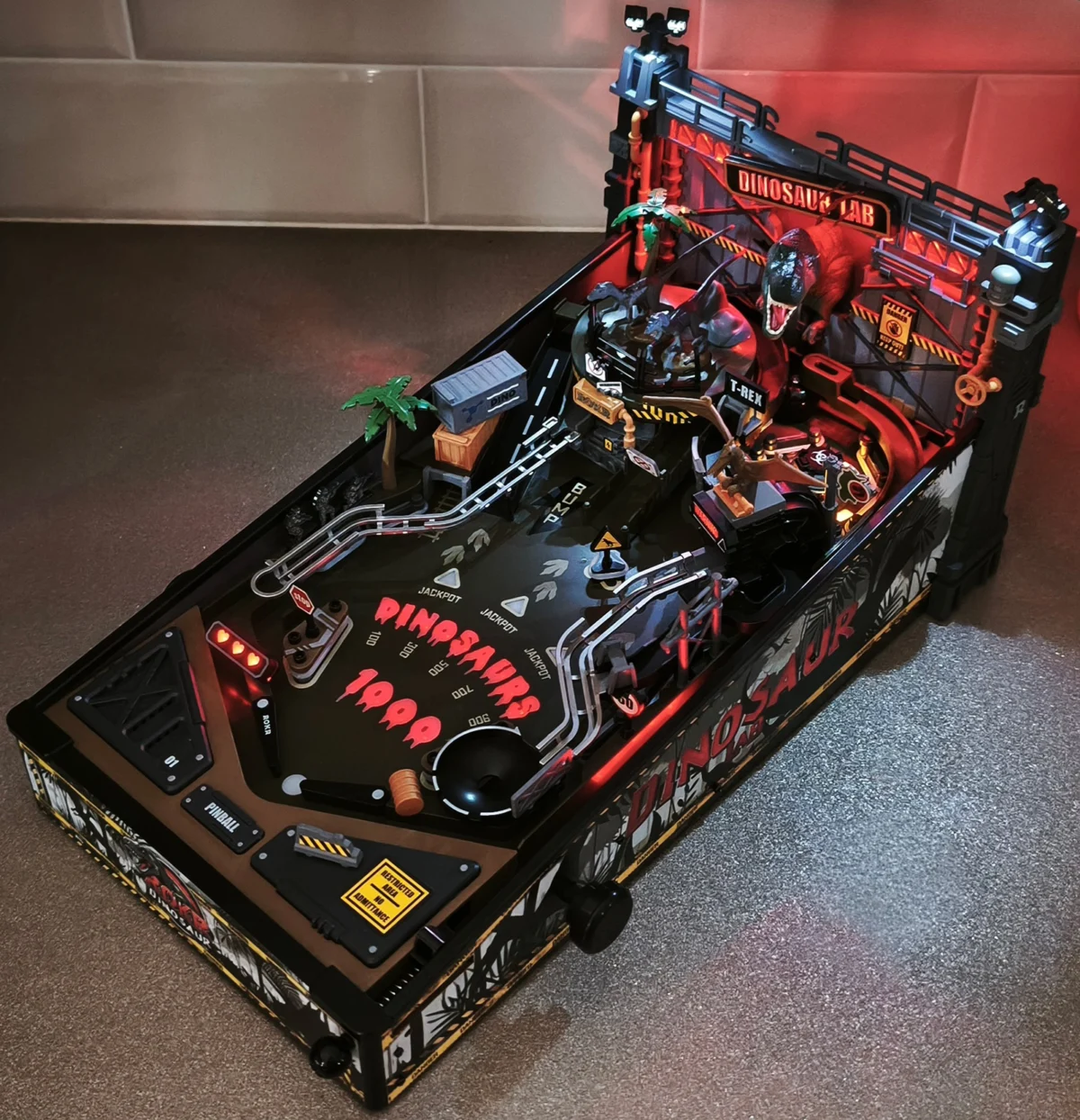
The packaging and shipping process also reflects a maturation of the brand. Units arriving at testing facilities are secured within rigid particleboard frames and protected by extensive buffering, a necessary upgrade given the sensitive nature of the onboard electronics. Unlike standard consumer toys, the kit includes specialized components—such as palm trees, Velociraptor figurines, and a Pterodactyl—that require manual installation to finalize the "Dinosaur Lab" theme. This emphasis on manual finalization reinforces the "builder’s pride" that defines the brand’s value proposition.

Technical Specifications and Gameplay Mechanics
The Dinosaur Lab functions as a fixed-slope, tabletop pinball unit. Unlike traditional commercial pinball machines, it lacks adjustable legs, relying on high-friction rubber feet for stability during play. The game is powered via a USB-C input (5V@2A), reflecting current consumer electronics standards.

The control scheme is intentionally minimalist but functional. Two manual flipper buttons dictate the force of the shot, requiring user skill to navigate the ball successfully. The playfield is organized into a seven-shot fan layout, featuring:

- The Left Lane: A high-difficulty dead-end shot that rewards players with a bell strike.
- The Left and Right Ramps: Utilizing opto-sensors to track ball movement and trigger scoring events.
- The Bump Target Bank: A single, multi-hit target that simulates a bank of three to progress through scoring goals.
- The Pop Bumper: The centerpiece of the game, which uses the ball to bridge an electrical circuit to trigger the solenoid.
The scoring system utilizes a "D-I-N-O-S-A-U-R-S" progression, where each letter corresponds to 100 points. The game logic is bifurcated into two modes: an "Easy" mode for casual play and a "Difficult" mode, which unlocks a "Wizard Mode" upon reaching 1,000 points. This Wizard Mode requires the player to hit all primary scoring lanes in a specific sequence, adding a layer of competitive depth that was largely absent in the previous generation of ROKR pinball kits.

Industry Implications and Market Impact
The release of the Dinosaur Lab illustrates a broader trend in the hobbyist sector: the gamification of construction kits. By incorporating electronic soundscapes, lighting effects, and rule-based gameplay, ROKR is effectively creating a hybrid category that appeals to both model builders and casual gamers.

The decision to move toward a more plastic-centric design may be viewed as controversial by purists who prize the tactile nature of wood, yet the functional improvements—namely the reduction of mechanical friction and the increased precision of the opto-sensors—suggest that the company is prioritizing longevity and playability. The "Dinosaur Lab" theme also provides a distinct competitive advantage, as it leans into a universally recognized pop-culture trope that offers more "shelf appeal" than the previous circus-themed model.

From an economic standpoint, the success of the Kickstarter campaign indicates that the market for premium, self-assembly desk toys remains vibrant. Even with the absence of a power supply in the box, the barrier to entry remains low enough for mass-market adoption while offering enough complexity to satisfy the "do-it-yourself" demographic.

Conclusion and Future Outlook
As of late 2026, the ROKR Dinosaur Lab is fulfilling its promise to thousands of backers. While the loss of the "all-wood" aesthetic is a notable shift, the trade-off in gameplay performance and thematic cohesion appears calculated to broaden the product’s appeal. The machine serves as a testament to the potential of desktop-scale mechanical engineering.

For the prospective buyer, the value of the Dinosaur Lab lies not just in the final, operational game, but in the roughly twelve-hour assembly process that precedes it. By forcing the user to engage with the inner workings of the solenoid, the wiring of the LEDs, and the alignment of the ramps, ROKR ensures that the owner gains a deeper appreciation for the mechanics of pinball. Whether this model marks a permanent shift toward plastic-hybrid construction or is simply a thematic experiment remains to be seen, but the Dinosaur Lab is, by all technical accounts, the most advanced kit ROKR has produced to date.