Indra Gunadi
The Technical Landscape of the Sega 32X
To understand the significance of Blade Arena: Kengeki, one must first consider the unique architectural constraints of the Sega 32X. Released by Sega in late 1994 as an add-on to the Sega Genesis (Mega Drive), the 32X was designed to bridge the gap between 16-bit gaming and the burgeoning 32-bit era. It featured two 23 MHz Hitachi SH-2 RISC microprocessors, a custom graphics processor capable of handling 32,768 colors, and a dedicated sound chip. Despite these specifications, the peripheral was notoriously difficult to develop for, as programmers had to manage the synchronization between the existing Motorola 68000 processor in the Genesis and the new SH-2 chips in the 32X.
For decades, the 32X library remained relatively stagnant, with many developers failing to fully utilize the potential of the dual-processor architecture. D-Mar’s work with Blade Arena: Kengeki represents a modern evolution in this domain. By employing optimized assembly code and refined rendering techniques, the developer has managed to achieve a level of fluid 3D movement and collision detection that many commercial titles of the 1990s struggled to replicate. The 4 MB cartridge limit, which was a standard constraint for high-end titles of the era, serves as a testament to the efficiency of the code, requiring meticulous memory management to store textures, polygon data, and character models.
Chronology of Development and Release
The development of Blade Arena: Kengeki follows a trend of increasing interest in 32X homebrew development that has gained momentum over the last five years. Throughout 2025, various technical forums and independent development circles saw a surge in documentation and open-source libraries aimed at lowering the barrier to entry for the SH-2 architecture. D-Mar’s project began during this period, with the developer focusing on a “Toshinden-style” structure—a reference to the seminal 3D fighting series Battle Arena Toshinden, which popularized weapon-based combat in a 3D arena environment.
The development lifecycle spanned approximately eighteen months, a relatively short duration for a 3D project on such archaic hardware. Key stages included:
- Phase 1: Engine Prototyping (Early 2025): Establishing the basic rendering pipeline on the SH-2 hardware to ensure frame rates could remain consistent during high-action sequences.
- Phase 2: Asset Implementation (Mid-2025 to Early 2026): Designing an original cast of characters, ensuring each possessed unique hitboxes and weapon animations.
- Phase 3: Optimization and Compression (Mid-2026): Scaling the game down to meet the 4 MB physical cartridge limitation, which involved sophisticated compression of sound samples and texture mapping.
- Phase 4: Final Release (October 2026): Deployment of the final ROM, accompanied by community testing and distribution through established retro-gaming repositories like PDroms.
Structural Analysis of Gameplay and Design
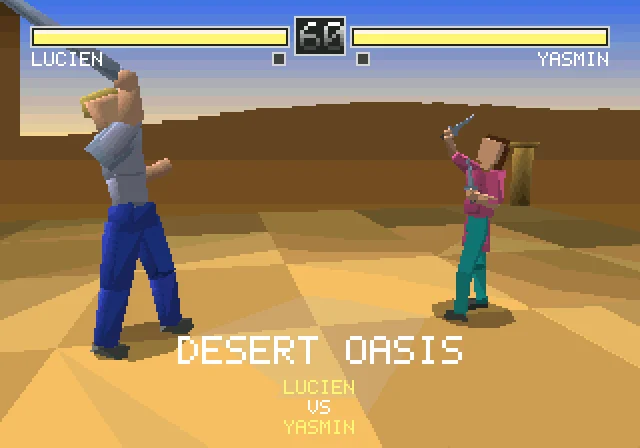
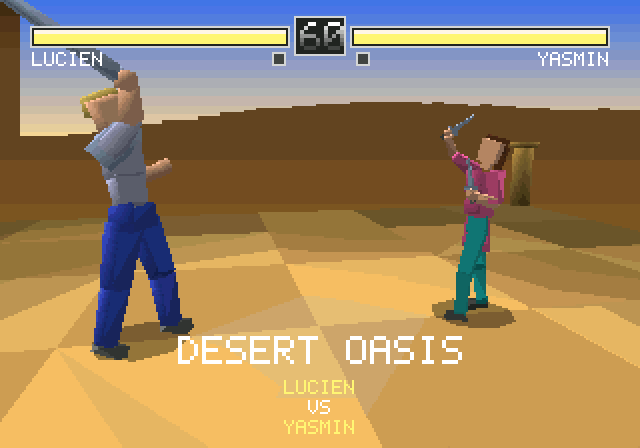
Blade Arena: Kengeki distinguishes itself from standard 2D fighting games by utilizing a Z-axis movement system, allowing players to sidestep projectiles and circle opponents in a 3D space. This creates a strategic layer of gameplay where positioning is as critical as frame-perfect execution of attacks. The reliance on weapon-based combat mechanics allows for longer reach and more varied animations compared to traditional punch-and-kick fighting games.
From a design perspective, the game utilizes a fixed camera system that follows the action, a common technique in 1990s console development to maintain performance while keeping the 3D models in focus. The use of polygon-based character models, rather than sprites, places the game firmly in the mid-90s aesthetic, reminiscent of early PlayStation or Sega Saturn titles. However, the 32X’s specific color palette and rendering quirks give the game a distinct visual identity that differentiates it from other platforms of that era.
Implications for the Retro Gaming Community
The release of Blade Arena: Kengeki is indicative of a broader trend: the democratization of high-level retro console development. With the advent of modern tools, such as cross-compilers and enhanced emulator debugging, independent developers are increasingly able to tackle "Tier 2" consoles that were previously considered too difficult or niche to support.
Industry observers note that projects like this serve as a vital preservation effort. By creating new, original software for discontinued platforms, the homebrew community keeps the hardware in use and prevents the total obsolescence of the technology. Furthermore, these projects provide a sandbox for developers to learn low-level programming, which remains a highly sought-after skill in fields like embedded systems and performance-critical software engineering.
Reactions and Industry Outlook
While Sega has not issued an official statement regarding the release, the reception within the enthusiast community has been overwhelmingly positive. Critics have praised the title for its technical achievement, specifically noting the stability of the frame rate during heavy character interaction. For the retro-gaming market, the availability of such titles keeps the interest in vintage hardware alive, fueling a secondary market for flash-carts, hardware modifications, and refurbished Sega 32X units.
The long-term implication for the Sega 32X is a re-evaluation of its status as a "failed" console. Often derided for its lack of a deep library and awkward design, the 32X is currently seeing a resurgence in appreciation. As developers continue to unlock the power of the dual SH-2 chips, the console is being repositioned as a platform for high-performance 3D experimentation.
Future Prospects for D-Mar and Similar Projects
The success of Blade Arena: Kengeki suggests that there is a sustainable audience for high-quality, original content on legacy platforms. D-Mar has indicated through community channels that the engine utilized for this title could potentially be adapted for other 3D genres, such as racing or adventure games. This modular approach to homebrew development could lead to a more interconnected ecosystem where developers share engines and assets, further accelerating the release schedule of new games for the Sega 32X and other 90s-era consoles.
As we look toward the future, the integration of AI-assisted development tools, as noted in the developer’s credits, points toward a new era of homebrew. These tools can assist in everything from pixel art scaling and texture generation to debugging complex assembly code, effectively lowering the barrier for individual developers to create substantial, high-fidelity experiences.
In conclusion, Blade Arena: Kengeki is more than just a new game for an old system; it is a testament to the enduring appeal of hardware-constrained programming and the passion of the developers who continue to breathe life into the systems of the past. By successfully managing the complexities of the Sega 32X’s dual-processor environment, D-Mar has set a new standard for what is possible on the console, ensuring that the legacy of the Sega 32X remains vibrant and relevant well into the future. The project stands as a benchmark for technical competence and artistic vision within the independent gaming sector, providing a blueprint for future developers to follow.