Indra Gunadi
The Evolution of 8-Bit Software Development
The Commodore 64 remains the best-selling single computer model of all time, with estimates placing total sales between 12.5 and 17 million units between 1982 and 1994. Because of this massive installed base, a robust "homebrew" community has persisted for decades, dedicated to pushing the hardware far beyond its original design specifications. The development of Yell At Clouds 2: Log Off is part of this broader movement, which seeks to modernize the user experience of legacy hardware.
Unlike contemporary high-definition gaming, where processing power is abundant, developers working on the C64 must navigate a landscape of severe constraints. The system is equipped with the MOS Technology 6510 microprocessor, running at a clock speed of approximately 1.023 MHz. To create a game that functions effectively, developers like J5 must write code directly in 6502 assembly—a low-level programming language that requires an intimate understanding of the machine’s memory registers, interrupt handlers, and color-cycling capabilities.
Narrative and Gameplay Mechanics
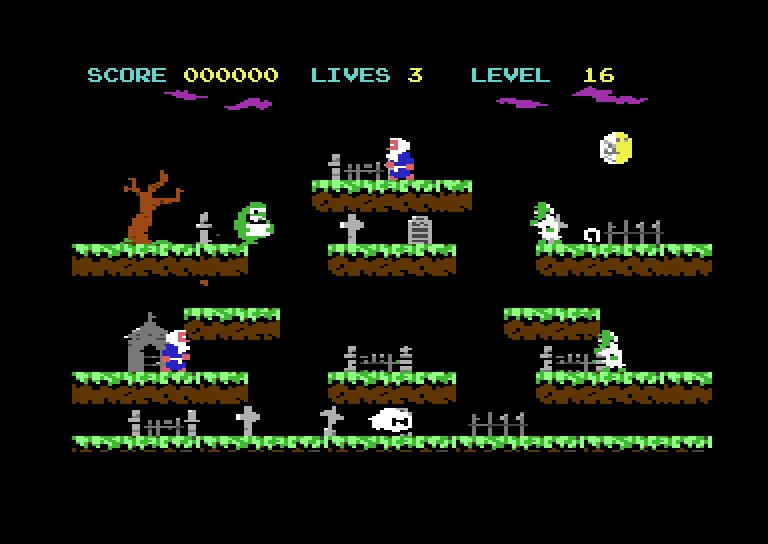
In Yell At Clouds 2: Log Off, the player assumes the role of a sentient, digital cloud entity. The premise involves the player "bubbling" various archetypes of early internet culture, specifically grumps, trolls, and "nekroposters"—a term referring to users who revive dead threads on archaic Bulletin Board Systems (BBS).
The game’s core loop relies on a high-speed arcade mechanic. As players interact with these digital manifestations, they must manage the screen real estate to prevent bubbles from bursting. When a bubble is permitted to burst, the antagonist returns to the screen with increased velocity and a distinct red coloration, signaling a higher difficulty level. This mechanic mirrors the "difficulty curve" found in classic arcade titles like Galaga or Defender, where increasing speed acts as the primary driver for gameplay progression. The integration of AI-assisted design has allowed J5 to optimize the movement patterns of these entities, creating a more fluid experience than would have been possible under traditional manual programming constraints of the 1980s.
The Role of AI in Retro Development
The mention of AI-assisted content—including graphics and music—in the production of Yell At Clouds 2: Log Off marks a shift in how retro-computing enthusiasts approach development. Historically, C64 software required artists to manually map pixels on a grid and composers to laboriously input notes into the SID chip’s registers.
By leveraging AI, developers are now able to generate assets that, while mathematically compatible with the C64’s color palette and sound capabilities, are created with greater efficiency. This does not replace the necessity of manual coding; the AI acts as a creative tool that handles the iteration of assets, while the human developer remains responsible for the "assembly" of the game within the machine’s limited 64KB RAM. This hybrid approach has allowed for an increase in the complexity of homebrew software, bridging the gap between the aesthetic of the 1980s and the efficiency of 2020s design workflows.
Chronology of the Commodore 64 Homebrew Scene
To understand the context of this release, one must examine the timeline of the C64 platform’s post-commercial life:
- 1994: Commodore International files for bankruptcy, effectively ending the mass-market production of the C64.
- 2000–2010: The rise of online communities like PDROMS and CSDb (Commodore Scene Database) creates a global repository for software, allowing developers to share code and technical discoveries.
- 2015–2020: The "Retro-Revival" period sees an explosion in physical media releases, with new games being sold on cartridges and floppy disks.
- 2023–2026: AI-assisted development tools become increasingly common in the homebrew space, allowing for more intricate graphical user interfaces and complex enemy behavior algorithms that previously would have exceeded the 1MHz processor’s capabilities.
Technical Analysis of 6502 Assembly Constraints
The use of 6502 assembly remains the "gold standard" for high-performance C64 software. The language allows for direct manipulation of the VIC-II (Video Interface Chip) and the SID (Sound Interface Device). In the case of Yell At Clouds 2: Log Off, the developer has had to allocate specific memory addresses for the "cloud" sprites and the "troll" enemies.
Because the C64 has only 64 kilobytes of memory, every instruction counts. An improperly optimized subroutine could lead to "flickering" or dropped frames. By using AI to assist in the generation of the assembly structure, J5 has essentially created a "modern-retro" hybrid that respects the hardware while introducing modern gaming sensibilities. The result is a game that feels native to the 1980s but functions with a level of responsiveness that would have been rare in the original commercial era.
Implications for the Future of Legacy Gaming
The release of this title highlights a growing trend: the commodification and professionalization of the homebrew scene. As the original developers of the 1980s move into retirement, a new generation of programmers, aided by advanced software tools, is taking over. This ensures that hardware which was once considered "obsolete" continues to generate new, original content.
Industry analysts observe that the preservation of these platforms is no longer just about nostalgia; it is about the mastery of constrained computing. Learning to code for the C64 requires a discipline that is often absent in high-level language environments like Python or C++. As such, titles like Yell At Clouds 2: Log Off serve as educational vehicles, demonstrating that even with a clock speed of just over 1 MHz, creative software design can yield engaging and complex experiences.
Official Reactions and Community Reception
Within the Commodore enthusiast community, the reception to J5’s latest work has been largely positive. On forums and platforms dedicated to the C64, the discussion has focused on the "tightness" of the game’s control scheme and the thematic relevance of the "BBS" aesthetic.
"The ability to capture the feeling of early, chaotic online discourse while staying within the memory limits of the C64 is a technical feat," noted an independent observer within the retro-gaming preservation sphere. "Using AI to assist in the generation of the background graphics and the sprite logic shows how we can keep these machines relevant for another forty years."
There is, however, an ongoing debate regarding the use of AI in retro-computing. Some purists argue that the "soul" of the machine is found in the manual, human effort of every pixel placement. Others, including developers like J5, argue that the goal of the scene is to see what the machine is capable of, regardless of the tools used to achieve the final binary. This debate is expected to continue as more developers incorporate generative AI into their workflows.
Conclusion
Yell At Clouds 2: Log Off is more than a simple arcade game; it is a synthesis of past and future technology. By utilizing the 6502 assembly architecture to process modern, AI-assisted design logic, J5 has successfully delivered a title that feels both nostalgic and refreshingly complex. As the Commodore 64 enters its fifth decade of existence, it is clear that the platform’s potential has yet to be fully exhausted. The success of this release underscores the vitality of the retro-computing community and the potential for even the most restricted hardware to remain a playground for innovation. Whether one views the software through the lens of history, technical challenge, or simple entertainment, it remains a definitive example of what is possible when modern ingenuity meets the timeless constraints of 8-bit computing.