Farhan hamdan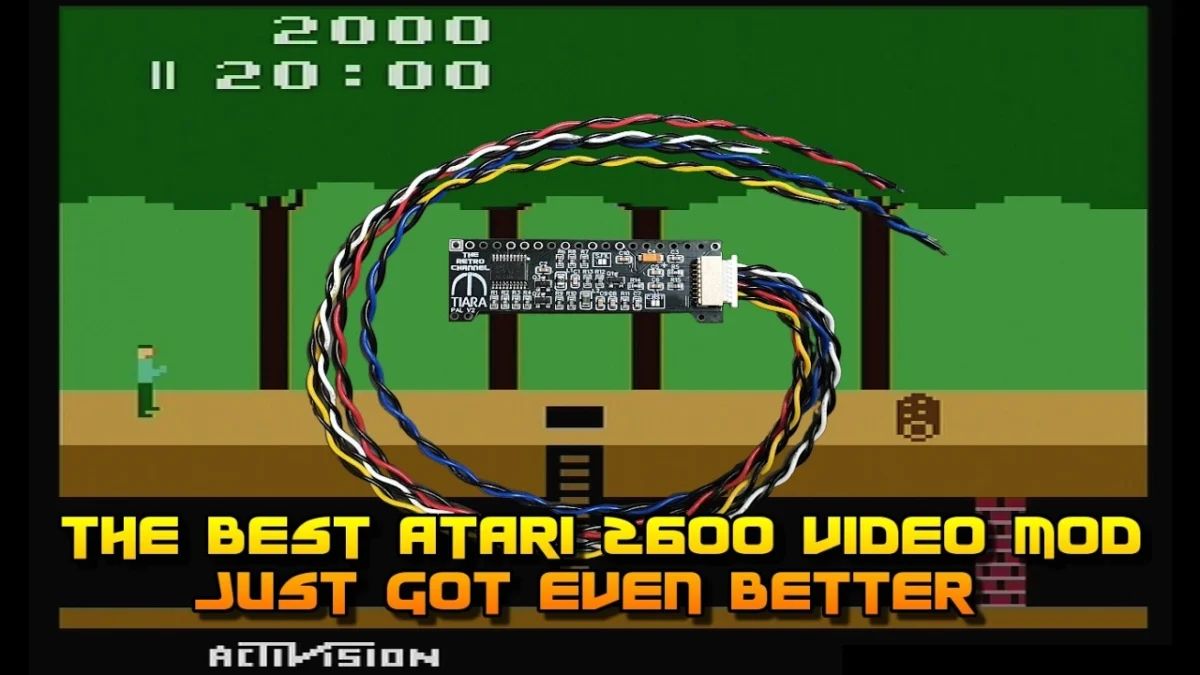
The retro gaming modification community has introduced a refined hardware solution for one of the most iconic video game consoles in history. Mark, operator of The Retro Channel, has officially launched the TIARA V2, a specialized Composite, S-Video, and audio modification board designed specifically for the Atari 2600. Priced at approximately $30 and available in dedicated PAL and NTSC variants, the new hardware aims to bridge the gap between vintage console architecture and modern display requirements. As enthusiasts increasingly seek pristine signal clarity for cathode-ray tube (CRT) televisions and modern flat-screen monitors alike, hardware modifications that bypass degraded radio frequency (RF) signals have experienced a significant resurgence in popularity within the global retrogaming ecosystem.
Engineering and Installation Innovations
The primary barrier to entry for many retro gaming enthusiasts considering hardware modifications has traditionally been the complexity of the installation process. Historical video output modifications often required intricate trace cutting, complex wiring harnesses, and advanced soldering skills that carried a high risk of permanent damage to vintage motherboards. The TIARA V2 addresses this usability hurdle through a streamlined drop-in architecture.
The installation procedure requires the user to position the modification board directly over the Television Interface Adapter (TIA) pins of the Atari 2600. Technicians only need to solder the specific holes featuring metal plating, drastically reducing the margin for error and minimizing the time required to complete the procedure. Furthermore, the hardware supports a completely non-destructive installation methodology, commonly referred to in the modding community as a "nocut mod." By routing signal wires through existing chassis openings to an external DIN connector, users can upgrade their video output without altering or permanently defacing the original plastic housing of the console.
For users seeking a simplified audio-visual setup, the board allows technicians to wire standard composite video and audio cables directly if S-Video output is not required. Additionally, the TIARA V2 is engineered for compatibility with more advanced video upgrades, enabling installation alongside the Lumacode modification without disabling the console’s native RF connection. This dual-compatibility approach ensures that purists and modern display enthusiasts alike can tailor their hardware to exact specifications without mutually exclusive compromises.
Compatibility Parameters and Technical Limitations
Despite its versatile engineering, the TIARA V2 is subject to specific hardware limitations that prospective buyers must consider. Most notably, the modification is fundamentally incompatible with the rare, late-model Atari 2600 Jr. units that utilize a "one-chip" design. These consolidated integrated circuit boards drastically altered the internal architecture of the console, eliminating the discrete TIA chip layout required for the TIARA board to interface correctly.
Furthermore, developers have noted that the TIARA V2 has not been formally tested, nor is it guaranteed to function properly, with non-standard regional variants of the console. This includes French SECAM systems, as well as South American PAL-N and PAL-M units, which historically utilized distinct color-encoding standards and RF modulation frequencies compared to standard North American NTSC and standard European PAL hardware.
Beyond console-specific hardware constraints, broader technical challenges exist regarding how modified and unmodified Atari 2600 systems interact with modern display technology. Contemporary flat-screen displays and dedicated video scalers are engineered around rigid timing standards that fundamentally differ from the analog signal generation of the late 1970s. Retrogame developers frequently exploited hardware quirks and undocumented quirks of the TIA chip—often referred to as software "tricks"—to generate graphics, colors, and resolutions that pushed the console far beyond its intended design parameters. While these programming methods rendered correctly on period-accurate CRTs, modern digital scalers frequently struggle to interpret these unconventional signals, leading to visual artifacts, frame drops, or total loss of sync. Comprehensive technical discussions hosted within communities such as AtariAge continue to document these display compatibility hurdles, underscoring the ongoing complexity of modernizing vintage digital hardware.
Historical Context and the Evolution of Video Output
To understand the significance of the TIARA V2, one must examine the historical context of video game hardware design during the late 1970s and early 1980s. When the Atari 2600—originally launched as the Atari Video Computer System (VCS) in October 1977—first entered the consumer market, televisions rarely featured dedicated auxiliary video inputs like composite RCA jacks or S-Video ports. Instead, home entertainment systems relied exclusively on antenna terminals.

To accommodate this infrastructure, home computers and video game consoles incorporated internal RF modulators. These components mixed the audio and video signals from the console’s internal hardware and modulated them onto a specific television broadcast channel, typically channel 2 or channel 3 in North America. While this approach ensured universal compatibility with virtually every household television of the era, it came at a severe cost to signal fidelity. RF transmission is highly susceptible to electromagnetic interference, signal degradation, and cross-color contamination, resulting in the characteristic blurry graphics, shimmering artifacts, and vertical banding commonly associated with classic gaming.
As cathode-ray tube televisions evolved throughout the 1980s and 1990s, manufacturers began incorporating composite video, S-Video, and eventually component video connections as standard features. Subsequent generations of video game consoles, beginning with systems like the Sega Master System and the Nintendo Entertainment System, routinely offered direct composite video output out of the box. However, the Atari 2600 remained anchored to its RF roots throughout its prolonged commercial lifespan, which officially concluded with its discontinuation in 1992. Consequently, generations of players experienced the platform through a noisy, low-fidelity television signal.
The Modern Case for Analog Video Modifications
In the contemporary era, the preservation and active utilization of vintage computing and gaming hardware have transformed from a niche hobby into a thriving global subculture. While high-end digital solutions—such as HDMI-modding boards, FPGA recreations, and advanced RGB or digital-to-analog converters—dominate discussions among hardcore preservationists, traditional analog displays retain a massive following.
Cathode-ray tube televisions remain the gold standard for experiencing analog-era video games due to their zero-latency response times, native handling of interlaced and progressive signals, and the natural scanline blending that softens harsh pixel edges. However, the external environment in which these systems operate has changed drastically over the past four decades. Modern residential areas are densely saturated with Wi-Fi networks, cellular towers, Bluetooth devices, and digital broadcasting signals that generate significant electromagnetic interference.
Under these modern environmental conditions, unshielded or poorly shielded RF cables frequently suffer from severe signal corruption. Field demonstrations conducted by retro gaming technicians illustrate a stark contrast in performance between rural and urban environments. In suburban or rural areas devoid of dense wireless infrastructure, a well-maintained RF cable can still deliver a surprisingly stable picture on a CRT. Conversely, users operating unmodded hardware in urban high-rises or densely populated neighborhoods are frequently met with severe static, herringbone patterns, and audio interference caused by neighboring wireless networks overpowering the fragile analog RF carrier wave.
By bypassing the RF modulation stage entirely, modifications like the TIARA V2 inject composite or S-Video signals directly into the display chain. S-Video separates the luminance (brightness) and chrominance (color) channels, effectively eliminating the dot crawl and color bleeding inherent to standard composite video. For enthusiasts utilizing CRTs in interference-heavy modern environments, this upgrade delivers a drastically sharper, cleaner image without requiring expensive external upscalers or permanently altering the console’s original aesthetic integrity.
Market Implications and the Future of Retrogaming Hardware
The commercial availability of the TIARA V2 through decentralized hardware platforms like Lectronz highlights the maturation of the independent retro gaming modification market. Rather than relying on large-scale electronics manufacturers—who abandoned support for these legacy architectures decades ago—the modern retrogaming community relies on independent engineers, open-source hardware designers, and specialized content creators to sustain the operational lifespan of vintage systems.
At a price point of approximately $30, modifications of this caliber democratize hardware maintenance, making advanced video upgrades accessible to casual collectors and hobbyist technicians alike. As original hardware components continue to age, the risk of component failure within vintage power supplies, capacitors, and modulator chips increases correspondingly. Implementing clean video modification boards not only enhances visual fidelity but often revitalizes aging units that might otherwise be retired due to failing RF modulator circuits.
Ultimately, products like the TIARA V2 underscore the enduring cultural and historical value of foundational video game hardware. By combining modern manufacturing efficiency with simplified, non-destructive installation techniques, hardware developers ensure that the Atari 2600 can continue to be experienced, studied, and enjoyed on authentic display equipment for generations to come. As the hardware modification landscape continues to evolve, the balance between preserving historical authenticity and maximizing modern usability will remain a central driving force for the engineering community dedicated to electronic preservation.