Jia Lissa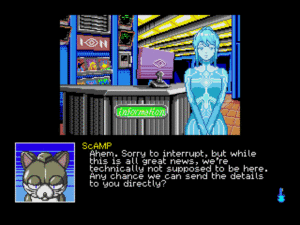
While the Sega CD became the industry benchmark for narrative-heavy graphic adventures in the early 1990s, the standard Sega Genesis (Mega Drive) cartridge format was historically limited by storage constraints. Titles like The Secret of Monkey Island and the cyberpunk cult classic Snatcher thrived on the high-capacity CD-ROM medium, allowing for digitized audio, cinematic cutscenes, and sprawling scripts. Historically, the Genesis library has been dominated by platformers, shooters, and sports titles, leaving a noticeable void for deep, menu-driven investigative adventures. Pixel Pusher Games is now challenging that historical limitation with its upcoming title, Chords, which aims to bridge the gap between traditional console limitations and the complexity of PC-style graphic adventures.
The Genesis of a New Narrative Experience
The project, spearheaded by lead developer Matt of Pixel Pusher Games, began as a technical and creative exploration into whether the 16-bit cartridge format could support the level of narrative density usually reserved for optical media. The core inspiration for the project is Hideo Kojima’s Snatcher, a game renowned for its noir atmosphere, branching dialogue, and intricate world-building. However, Pixel Pusher Games has explicitly stated that while the mechanical framework of Chords pays homage to the Kojima classic, the game is being developed as a standalone intellectual property with a unique aesthetic and thematic focus.
The development process has been methodical, spanning several years to ensure that the technical limitations of the Motorola 68000 processor—the heart of the Genesis—are navigated without sacrificing the game’s cinematic aspirations. Unlike many indie projects that rely on modern engines, Chords is being built with a focus on authentic hardware compatibility, ensuring that it functions as a true-to-era Genesis release.
Narrative Scope and Gameplay Mechanics
The plot of Chords revolves around the protagonist, Akio, an aspiring musician navigating a high-stakes global battle-of-the-bands competition. The narrative is structured in three distinct parts, designed to provide a cohesive, multi-hour experience. Early benchmarks from the development team indicate that a single chapter can require approximately 45 minutes of gameplay for an experienced player, suggesting a total runtime that rivals the most substantial adventure titles of the 16-bit era.
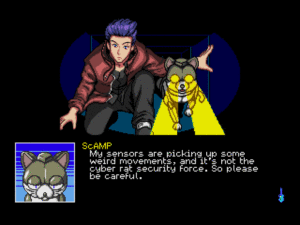
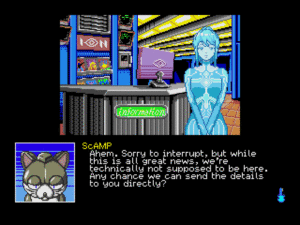
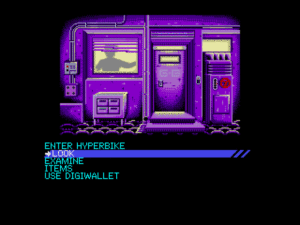
Gameplay follows the classic "graphic adventure" paradigm, utilizing a command-based interface. Players must interact with their environment through specific actions such as "move," "look," and "talk." This design choice is intentional; it forces the player to engage with the game’s world on a granular level. The puzzles are not designed to be insurmountable obstacles but rather to encourage environmental observation. Developers have noted that success in Chords often depends on synthesizing information gathered from ambient dialogue, background details in pixel art, and logical deduction. This design philosophy seeks to reward the player’s attentiveness, as small, easily overlooked clues are often the keys to unlocking narrative progression.
Technical Craftsmanship and Artistic Direction
A significant portion of the game’s appeal lies in its production values. Pixel Pusher Games has enlisted industry-proven talent to ensure the game meets modern expectations while maintaining a retro-authentic look. The pixel artwork is helmed by Daniel “108 Stars” H., whose previous work on the acclaimed RPG Pier Solar demonstrates a mastery of the Genesis hardware’s color palette and tile-map limitations.
Complementing the visuals is a chiptune soundtrack composed by SuperJet Spade. In a genre where atmosphere is paramount, the score is designed to be as vital as the dialogue. Furthermore, the studio has made a conscious effort to ensure global accessibility. The game will launch with support for English, French, German, Spanish, and Portuguese, a nod to the enduring international community of Sega enthusiasts who continue to support the console decades after its commercial sunset.
Market Context and Industry Implications
The emergence of Chords occurs within a broader, burgeoning trend of independent development for legacy hardware. Over the last decade, the "homebrew" scene has evolved from hobbyist efforts into a legitimate sub-sector of the gaming industry. Developers are increasingly moving away from simple arcade clones toward complex, story-driven experiences that push the boundaries of what consoles like the Genesis were once thought capable of.
This shift has significant implications for the preservation and longevity of classic consoles. By developing new, high-quality software, studios like Pixel Pusher Games are extending the lifecycle of the hardware, transforming the Genesis from a static piece of vintage technology into a platform for modern creative expression. The success of such titles is also supported by a robust secondary market for physical media, where collectors and enthusiasts demonstrate a high willingness to invest in high-quality, boxed, and complete-in-box (CIB) physical releases.
Comparative Analysis: Cartridge vs. CD-ROM
The historical debate regarding the superiority of the Sega CD over the cartridge format centered on the sheer volume of assets—specifically voice acting and pre-rendered cinematics. By opting for a cartridge release, Pixel Pusher Games must rely on superior programming efficiency and artistic design rather than "brute force" storage.
If Chords successfully delivers an immersive experience comparable to the Sega CD’s library, it could serve as a case study for future developers. It demonstrates that with optimized code and a focus on core gameplay loops, the technical constraints of the cartridge format can be mitigated. This "less is more" approach has historically been the hallmark of the most successful 16-bit games, and Chords appears to be applying this logic to the adventure genre, which has traditionally been the most "data-hungry" category of software.
Future Outlook and Development Roadmap
As development moves toward its final stages, the team at Pixel Pusher Games has maintained a transparent development cycle. By engaging with the community via platforms like BlueSky and their official website, the developers have cultivated a dedicated audience. In addition to Chords, the studio is also working on a dungeon crawler titled Crypt of Dracula. The simultaneous development of two distinct projects suggests a high level of confidence and organizational maturity within the studio.
The release of Chords will be a significant milestone for the Genesis scene, providing a sophisticated alternative to the abundance of shooters and action-platformers that currently populate the indie landscape for the console. While a definitive release date for both the physical and digital versions remains pending, the progress of the current demo suggests a polished final product.
For those interested in the preservation of the graphic adventure genre, Chords represents a bridge between eras. It utilizes the mechanical foundations established by legends like Kojima while carving out a distinct identity through its focus on musical themes, original narrative, and artistic depth. As the industry continues to monitor the intersection of modern design and retro hardware, Chords is positioned to become a benchmark for what is possible on the Sega Genesis in the modern era. The combination of professional-grade pixel art, a multi-language localization strategy, and a commitment to high-fidelity storytelling makes this one of the most anticipated titles for the console’s ongoing, vibrant, and ever-evolving library.