Jia Lissa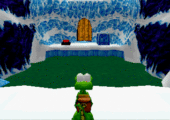
The transition from two-dimensional sprite-based gameplay to immersive, polygonal 3D environments represents arguably the most significant paradigm shift in the history of interactive entertainment. While arcade technology laid the initial groundwork in the early 1990s, the true maturation of this medium occurred within the living room, driven by the emergence of 32-bit and 64-bit home consoles. Among these, the Sega Saturn struggled to maintain market parity with the Sony PlayStation and Nintendo 64. However, the console’s library was bolstered by third-party titles that sought to define the nascent 3D platforming genre. One of the most notable, albeit complex, entries in this era was Croc: Legend of the Gobbos, developed by Argonaut Software and released in 1997.
Origins and the Nintendo Connection
The genesis of Croc: Legend of the Gobbos is inextricably linked to the competitive landscape of mid-90s game development. Argonaut Software, a British studio led by Jez San, had established a robust technical reputation through its collaboration with Nintendo on the Super FX chip, which powered the 1993 hit Star Fox. This partnership provided Argonaut with early access to Nintendo’s hardware philosophy.
Following the success of Star Fox, Argonaut pitched a concept to Nintendo involving a 3D platforming and racing hybrid starring Yoshi, the iconic reptilian companion of Mario. Historical accounts from Argonaut’s leadership suggest that the pitch was met with institutional resistance. At the time, Nintendo was internalizing the development of Super Mario 64, a project that would eventually set the industry standard for 3D navigation. Nintendo’s corporate strategy was historically protective of its intellectual property; the company had never permitted a third-party developer to utilize its flagship characters. Consequently, the proposal was rejected. Rather than abandoning the technical framework they had developed, Argonaut pivoted, rebranding the protagonist as a crocodile and finalizing the title as an independent project.
Technical Hurdles and Hardware Constraints
When Croc was released in 1997, it arrived in a market segment dominated by the PlayStation’s architecture. The Sega Saturn version, while technically competent, highlighted the difficulties developers faced when porting 3D titles across hardware with varying geometry processing capabilities.
The Saturn version was plagued by performance discrepancies, most notably a peculiar visual bug that resulted in the loss of character geometry—specifically the protagonist’s snout—if the game was initialized while the disc was already inside the console. This "body horror" glitch, caused by improper memory initialization during the BIOS boot sequence, forced players to adopt specific startup rituals. Furthermore, the Saturn’s rendering engine often resulted in grainier textures and a more somber color palette compared to the vibrant output of the PlayStation. Despite these technical limitations, the game was a necessary addition to the Saturn’s library, which famously lacked a first-party 3D platformer featuring a mascot comparable to Sonic the Hedgehog.
Gameplay Mechanics and Design Philosophy
Croc: Legend of the Gobbos operates on a system of tank controls, a decision that has become a point of contention in retrospective analysis. Unlike the fluid, analog-based movement seen in Super Mario 64 (1996) or the later Spyro the Dragon (1998), Croc requires players to rotate the character in place before moving forward.
This design choice suggests that Argonaut was still grappling with the complexities of camera positioning and spatial orientation in a 3D space. The level design, however, remains a highlight of the title. Each world is partitioned into distinct, logical "rooms," ensuring that the player is rarely lost or forced to perform "leaps of faith." Objectives are clearly telegraphed: players must navigate environments to collect Gobbos, utilizing specific keys and color-coded gems to unlock hidden paths. While the enemy AI is rudimentary—characterized by predictable, looping movement patterns and frequent respawning—the structural integrity of the levels demonstrates a sophisticated understanding of player guidance and spatial pacing.
Audio-Visual Identity and Cultural Legacy
The game’s aesthetic was largely defined by its soundtrack and sound design. The menu theme, characterized by an upbeat, mariachi-infused brass arrangement, remains one of the most recognizable compositions of the 32-bit era. This audio identity provided a sense of charm that contrasted with the more abstract, lonely environments of the game’s four worlds: Forest, Ice, Desert, and Castle.
The lack of traditional dialogue was a strategic creative choice. Instead, the game relied on expressive, cartoonish sound effects and vocalizations. These "kersplats" and startled stammers served to humanize the protagonist in the absence of a complex narrative. While the story of Croc being raised by the Gobbos and fighting the antagonist Baron Dante is standard for the genre, these auditory cues provided the necessary character depth to sustain player engagement throughout the 1,200-plus-day development cycle.
Market Performance and Modern Re-evaluation
At the time of its release, Croc: Legend of the Gobbos was viewed as a solid, if slightly derivative, entrant into the 3D platforming space. Its reliance on established tropes—collect-a-thon mechanics, basic boss encounters, and environment-based hazards—mirrored the industry’s experimental approach to the third dimension.
In 2025, the release of a modernized remaster has provided a new lens through which to view the title. The inclusion of contemporary control schemes addresses the primary grievance of original players, allowing the core level design to be appreciated without the friction of 1997-era movement limitations. This remastering effort underscores the enduring appeal of the game’s foundational design, which, despite the limitations of its time, avoided the trap of unfair or obscure progression requirements.
Broader Implications for the Industry
The history of Croc provides a valuable case study for the evolution of software development in the 1990s. It serves as a reminder that before the solidification of genre conventions, developers were forced to operate on "gut feeling." The transition to 3D was not merely a graphical upgrade; it was a fundamental shift in how developers communicated space and intent to the player.
The rejection of Argonaut’s Yoshi pitch by Nintendo arguably redirected the trajectory of the studio, forcing them to build an original property that, while arguably less polished than the first-party giants of the era, contributed significantly to the democratization of 3D gaming. By analyzing the successes and failures of such titles, contemporary developers gain a clearer understanding of the "leaps of faith" that were required to pioneer modern gaming. Today, Croc: Legend of the Gobbos stands as a relic of a time when the industry was still learning the rules of its own new world—a testament to the ambition of mid-sized studios during the most volatile period of gaming history. Through both its original flaws and its intelligent design, it remains a vital entry in the annals of platforming history, reflecting the unique blend of technical experimentation and creative risk-taking that defined the late twentieth century.