Jia Lissa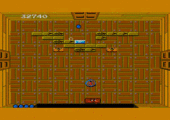
The landscape of 8-bit home console gaming in the late 1980s was defined by rapid experimentation and the adaptation of arcade-proven mechanics for living room hardware. Among these technical pivots was the development of the Sega Mark III’s paddle controller, a peripheral designed to bridge the gap between digital directional pads and the precise analog input required for the block-breaking genre. Released in 1987 as the final title in Sega’s "My Card" software line, Woody Pop: Shinjinrui no Block Kuzugi serves as a critical case study in how hardware limitations and design choices intersected during the transition from the Atari 2600 era to the more sophisticated architectures of the Famicom and Sega Mark III.
The Evolution of Paddle-Based Gaming
The block-breaking genre, popularized by Atari’s 1976 arcade hit Breakout and its sequel, Super Breakout, relied heavily on the potentiometer-based paddle controller. Unlike the binary on-off nature of a standard digital D-pad, the paddle offered a linear range of motion, allowing players to map the physical position of their hand to the position of the on-screen paddle. This precision was essential for the rapid-fire deflection of projectiles.
By the mid-1980s, the emergence of Taito’s Arkanoid—which introduced power-ups, enemy movement, and varied brick durability—revitalized the genre. However, the move to home consoles created a hardware disparity. While the Atari 2600 included native paddle support, Nintendo’s Famicom did not. This forced Taito to bundle a proprietary paddle controller with its home port of Arkanoid. Sega, despite having no significant arcade pedigree in the block-breaker subgenre, followed this trend in 1987 by launching its own paddle peripheral, which was bundled with two specific software releases: Woody Pop (on a My Card) and Alex Kidd BMX Trial (on a 1Mb Gold Cartridge).
Technical Specifications and Software Distribution
The Sega paddle controller was a niche peripheral, supported by a total of seven titles on the Mark III. Of these, four were exclusive to the controller, representing a significant investment for a peripheral that never saw a Western release. The following list outlines the chronological and structural approach Sega took toward the hardware:
- 1987: Introduction of the Sega Paddle Controller alongside the bundled release of Woody Pop and Alex Kidd BMX Trial.
- The Software Portfolio: The seven supported titles included Woody Pop, Megumi Rescue, and several other titles that attempted to utilize the controller’s analog input to simulate arcade-grade precision.
- Regional Disparities: While the Atari 2600 boasted over 30 titles utilizing paddle controllers in the West, the NES generation saw a precipitous decline in such support, with the original Arkanoid being the sole recipient of dedicated paddle peripheral support in North American markets.
Design Analysis of Woody Pop
Woody Pop was developed as a direct competitor to the Arkanoid formula, though it attempted to introduce mechanical depth that its predecessors lacked. The game features a protagonist named Woody—a "wood spirit"—tasked with navigating the "Bizarre Mansion." Unlike the sterile, high-contrast aesthetic of Arkanoid, Woody Pop utilized a warmer, earth-toned palette.
Functionally, the game introduced several notable features:
- Dynamic Environmental Feedback: Bricks in Woody Pop visually deteriorate upon impact, providing a clear indicator of structural integrity—a feature missing from the original Arkanoid.
- Branching Path Logic: Players were afforded the choice of different rooms upon the completion of a level, theoretically adding non-linear progression to the standard block-breaking loop.
- Power-Up Synergies: The game allowed for the stacking of certain power-ups, such as the "Glue" item (which allows the paddle to catch the ball) and the "Flame" item (which increases projectile damage), creating a layer of tactical management.
Despite these innovations, the title faced significant hurdles in execution. The playfield was designed for a 4:3 console aspect ratio, which was wider than the vertically oriented displays of traditional arcade cabinets. This forced players to cover more ground with the paddle. Furthermore, the game’s difficulty curve—characterized by a rapid increase in ball velocity and the inclusion of static obstacles like moving trains—often rendered the increased screen width a liability rather than an advantage.
Criticisms and Performance Metrics
The reception of Woody Pop among technical analysts and contemporary players centers on the discrepancy between its mechanical ambition and its visual output. The "Bizarre Mansion" setting, heavily reliant on shades of brown and orange, frequently obscured the game’s active elements, such as the protagonist and the ball. This, combined with a soundtrack that largely comprised rhythmic sound effects rather than melodic compositions, resulted in a sensory experience that many found disjointed.
The game also struggled with pacing issues. The introduction of "warp holes" and "toy box" enemies—which could be perpetually triggered to spawn waves of tin soldiers—created bottlenecks. In an era where arcade games were designed to maximize turnover by being fast-paced and challenging, these features in Woody Pop were often viewed as contributors to artificial difficulty rather than genuine gameplay complexity.
The Broader Impact on the Industry
The decision by Sega to invest in a proprietary paddle controller for a system that lacked a strong library of compatible games suggests a strategic attempt to maintain the "arcade-at-home" ethos that the company prided itself on. While the controller itself was a capable piece of hardware, its limited adoption highlights the challenges of peripheral-dependent software.
The legacy of Woody Pop is largely categorized as a "missing link" in the evolution of the genre. While it preceded more modern takes on the block-breaker, such as Wizorb, it failed to resolve the inherent friction between arcade-style mechanics and console-style display limitations. Today, Woody Pop is viewed primarily as a collector’s item—a necessity for those seeking to complete a Sega Mark III collection or those interested in the history of input devices.
Conclusion: The Cost of Innovation
In retrospect, the 1987 release of Woody Pop serves as a reminder of the experimental period of 8-bit console gaming. The game offered genuine advancements in genre mechanics, including branching paths and visual damage feedback, yet these were undermined by poor color contrast, repetitive sound design, and questionable level architecture.
From an objective standpoint, the inclusion of the paddle controller was a significant hardware investment by Sega, yet it failed to gain the necessary software momentum to survive beyond its limited initial run. By the time the industry shifted toward the 16-bit era, the reliance on specialized analog controllers for simple block-breaking games had largely vanished, making Woody Pop an artifact of a specific, narrow period in gaming history. With a critical score of 4 out of 10, the title remains a curiosity—a testament to the ambition of a developer attempting to push a genre forward, even when the underlying hardware and design constraints were not yet fully reconciled.