Cecilia Chamidah Nur
In an increasingly saturated video game market, where developers and publishers grapple with an overwhelming tide of new releases, the art of standing out has become a critical challenge. Generic marketing often falls flat, making innovative campaigns a breath of fresh air. One such example making waves is Dungeon Lurker, a side-scrolling action-adventure roguelike from 13AM Games, which was announced at the recent MIX Summer Game Showcase. The title is not merely relying on its gameplay merits but is captivating audiences with an exceptionally clever, ’90s-inspired marketing campaign that taps directly into gamer nostalgia.
The Game: Beneath the Pixelated Surface
At its core, Dungeon Lurker presents itself as a classic side-scrolling action-adventure roguelike. Players are tasked with delving into the cursed depths of a sprawling dungeon, battling various foes, and ultimately uncovering a sinister secret. Between perilous runs, the opportunity arises to upgrade equipment, spells, and charms, offering a familiar yet engaging loop for fans of the genre. However, a deeper look at its promotional materials reveals a narrative ambition that transcends typical dungeon-crawling mechanics.
The game’s announcement trailer hinted at a compelling meta-narrative, reminiscent of films like Jumanji. It subtly introduces a story involving a missing child, his childhood friend, and a supernatural video game that shares the title of Dungeon Lurker itself. This "game within a game" concept forms the backbone of a sophisticated, ’90s-inspired storytelling approach. Creative Director Alex Rushdy elaborated on this, stating, "Dungeon Lurker is about playing through a retro game for the console named ‘The Eclipse System 32.’ And that game you are playing belonged to someone before you. When you first boot up the game, you’ll actually see their save file. Finding out who owned this game before you is part of the mystery." This narrative layer promises to add significant depth, encouraging players to explore not just the dungeon’s secrets but also the enigmatic history of the game they are playing. The initial reaction from the gaming community has been overwhelmingly positive, with many expressing intrigue about these narrative breadcrumbs.
A Deep Dive into Era-Accurate Marketing
What truly sets Dungeon Lurker apart in the crowded indie scene is its meticulously crafted marketing strategy. 13AM Games, in collaboration with their marketing partners, CONTINUE, has orchestrated a campaign that feels like a genuine relic from the mid-1990s. This includes the creation of a fictional 32-bit console dubbed "The Eclipse System 32," a clever nod to the era’s hardware arms race.

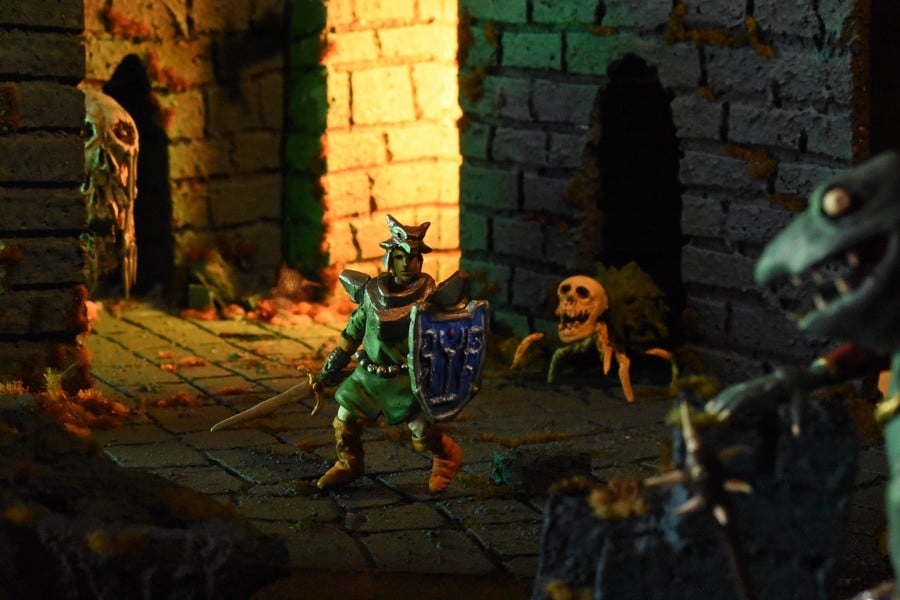
The marketing extends to "era-accurate" print advertisements, which feature a stunning diorama created by Spanish artist and sculptor Plastiboo. These ads, designed to evoke the aesthetic of gaming magazines from the period, are a testament to the team’s commitment to authenticity. Complementing this is a website (dungeonlurker.com) that perfectly mimics the look and feel of early internet pages, complete with pixelated graphics, rudimentary navigation, and a distinct lack of modern web design conventions. This level of detail stands in stark contrast to the often-criticized trend of generic, AI-produced key art and marketing materials prevalent in today’s industry. The deliberate embrace of tangible, artisanal marketing elements serves not only as a nostalgic draw but also as a powerful statement against the homogenization of digital promotion. This strategy effectively bypasses the usual noise of digital marketing, capturing attention through its sheer uniqueness and dedication to a specific cultural moment.
Interview with Alex Rushdy: The Vision Behind the Nostalgia
Time Extension had the opportunity to speak with Alex Rushdy, CEO of 13AM Games and Creative Director on Dungeon Lurker, to delve deeper into the project’s inspirations and the philosophy behind its distinctive marketing.
The Allure of the 32-bit Era: Rushdy expressed a profound personal connection to the 32-bit era of gaming, particularly the transitional period between 16-bit consoles and the full emergence of 3D. "I have a real fondness for that strange growing era between the 16-bit consoles and the 32-bit ones," he stated, referencing systems like the SEGA CD, 32X, Amiga CD32, 3DO, and CDi. He highlighted the "certain uncanniness" of these consoles and the "sense of archaeology" that comes from discovering and playing their less common titles today. This era, often overshadowed by the later PlayStation and Nintendo 64 dominance, was a crucible of innovation where 2D artistry coexisted with burgeoning 3D graphics, often with striking results through sprite scaling and pre-rendered assets. Rushdy pointed to titles like Rayman, Astal, Warrior Blade, Darius Gaiden, RayForce, and Guardian Heroes as exemplars of the stunning visual work achieved during this period.
Arcade Roots and Core Inspirations: While Rushdy appreciated the home console landscape, his early gaming experiences were primarily shaped by the arcade. "As a kid, I only really had access to the 16-bit stuff myself. When it came to appreciating that ‘era’ of gaming, I was much more entranced by the arcade. For me, that’s where the real action was!" he recalled. He fondly remembered being "floored" by fighting games like King of Fighters and beat-em-ups such as Rampage World Tour and Gauntlet Legends. Even older classics like Altered Beast and Wonder Boy in Monster Land consumed his summer allowance. This strong arcade foundation is evident in Dungeon Lurker’s emphasis on tight controls and action-oriented gameplay.
Specific Game Influences: Rushdy singled out two titles as having an "incredible impact" on Dungeon Lurker’s design:
-
Magic Sword (1990 Capcom arcade game, SNES port): "The idea of progressing up through a tower, being able to take shortcuts, finding randomly generated power-ups and items, discovering secrets, getting new blades, etc., are all ideas directly inspired by Magic Sword; we just have you going down into a dungeon instead of up a tower," Rushdy explained. He praised Magic Sword as an "underappreciated gem" for its unique variables and replayability, noting its "incredible music" and the strategic depth offered by its varied runs. The core concept of iterative progression and discovery, albeit inverted, forms a foundational pillar of Dungeon Lurker’s roguelike structure.

-
Warrior Blade, aka Rastan Saga III (1991 arcade beat-em-up): Rushdy lauded Warrior Blade for its "stunning game, visually" and its "unique aesthetic with these huge, detailed sprites and the 8:3 aspect ratio." He also highlighted its innovative non-linear level structure, where players could choose the order of four main levels, each granting a special power that aided in subsequent challenges. This aspect of player choice and strategic power acquisition has clearly influenced Dungeon Lurker’s design, suggesting a similar emphasis on emergent gameplay and adaptive strategies.
Artistic Direction: Blending 2D Aesthetics with Modern Design
The visual fidelity of Dungeon Lurker, particularly its pixel artwork and character animation, has garnered significant praise. Rushdy clarified that a fully 3D perspective was never a consideration for the team. "There are some great 32-bit-inspired 3D games on the market right now, but we wanted to try something different," he stated.
His preference for a beat-em-up camera and control style stems from a desire to focus solely on player control without the added complexity of camera manipulation. "I’ve always felt that the camera-and-control style was a little underexplored. I tend to really enjoy games where I don’t have to control the camera; I just control the player. Beat ’em ups do that really nicely in a pseudo-3D space," Rushdy elaborated. The team aimed to apply this language and style to a dungeon crawler, allowing players to explore rather than simply moving left-to-right. He cited Namco’s Splatterhouse 3 and Taito’s Light Bringer (aka Dungeon Magic) as rare examples that successfully implemented a similar concept.
The visual excellence is further bolstered by the involvement of a team of "incredibly talented artists" who have contributed to acclaimed pixel art titles such as Katana Zero, Skullgirls, and Blasphemous. This collaborative effort allows these artists to "unleash their pixel art skills," resulting in a game that pushes the boundaries of modern 2D artistry while remaining faithful to its retro inspirations.
Championing 2D in a 3D World: The 32-bit Legacy
During the 32-bit era, the video game industry experienced a significant paradigm shift, with publishers and retailers aggressively pushing developers towards the third dimension. Despite this prevailing trend, many studios continued to produce exceptional 2D titles, demonstrating the enduring artistic and technical potential of pixel art.
Rushdy highlighted the Taito F3 System, a 32-bit arcade board, as a pinnacle of 2D game development. Titles like Darius Gaiden, RayForce, and Elevator Action Returns exemplify "the apex of hand-drawn pixel art." He placed these alongside other arcade heavyweights such as Metal Slug, In the Hunt, Garou, and Street Fighter III, emphasizing the incredible artistic achievements in arcades during that period.
On the home console front, Rushdy pointed to several 2D masterpieces that defied the 3D trend: Guardian Heroes (Sega Saturn), Cotton 2/Boomerang, Gradius Gaiden (PlayStation), Mega Man X4 (PlayStation), and Castlevania: Symphony of the Night (PlayStation). These games not only showcased the continued viability of 2D graphics but also pushed artistic and gameplay boundaries, proving that innovation was not exclusive to the third dimension. They remain highly regarded for their intricate sprites, fluid animation, and timeless gameplay.
Broader Implications: Marketing Innovation and Indie Visibility
The marketing campaign for Dungeon Lurker represents a significant case study in how indie developers can cut through the noise. In an ecosystem where thousands of games are released annually, relying solely on digital storefront visibility or paid ads can be financially prohibitive and often ineffective for smaller studios. By crafting a campaign that is inherently unique, deeply nostalgic, and physically tangible (through print ad dioramas), 13AM Games has created a memorable identity for Dungeon Lurker long before its release.
This strategy taps into the powerful psychological appeal of nostalgia, particularly for a demographic of gamers who grew up during the ’90s. It fosters a deeper, more emotional connection than a generic trailer or press release ever could. The "meta-narrative" and the "game within a game" concept further enhance this, inviting players to participate in a larger mystery that blurs the lines between the game world and their own past experiences.
The success of this approach could inspire other indie developers to think more creatively about their marketing, moving beyond conventional digital channels and exploring unique, authentic ways to engage their target audience. It underscores the value of genuine passion and attention to detail, not just in game development but also in its promotion. As 13AM Games prepares for further showcases at Gamescom, PAX, and Tokyo Game Show, along with ongoing community engagement via social media and their retro website, Dungeon Lurker is poised to make a lasting impression, not just as a promising roguelike but as a masterclass in innovative, era-accurate marketing.