Edi Durjana
RetroArch, the ubiquitous open-source frontend for the Libretro API, has officially released its highly anticipated version 1.20.0, marking a significant milestone in the world of video game emulation and preservation. This latest iteration introduces groundbreaking features, most notably an advanced CRT beam simulation shader developed in collaboration with industry luminaries, and pioneering illuminance sensor support for Linux, allowing for an unprecedented level of authenticity in emulating hardware-dependent game mechanics. The release underscores RetroArch’s unwavering commitment to enhancing the end-user experience without resorting to intrusive monetization schemes, relying instead on a robust community support model.
The 1.20.0 update is available for immediate download across a multitude of platforms via the official RetroArch website. This project, driven by a passionate community and dedicated developers, has consistently prioritized user access and quality over commercial interests. In an era where many software solutions adopt in-app advertisements, monetization SDKs, or paywalled features, RetroArch steadfastly maintains its free and open-source ethos. This commitment is sustained through voluntary donations, with users encouraged to support development via platforms like Patreon and Github Sponsors, or by purchasing official merchandise from their Teespring store. This funding model ensures that innovation remains focused on user benefit, free from external commercial pressures.
A New Era for Visual Fidelity: Shader Subframes and CRT Beam Simulation
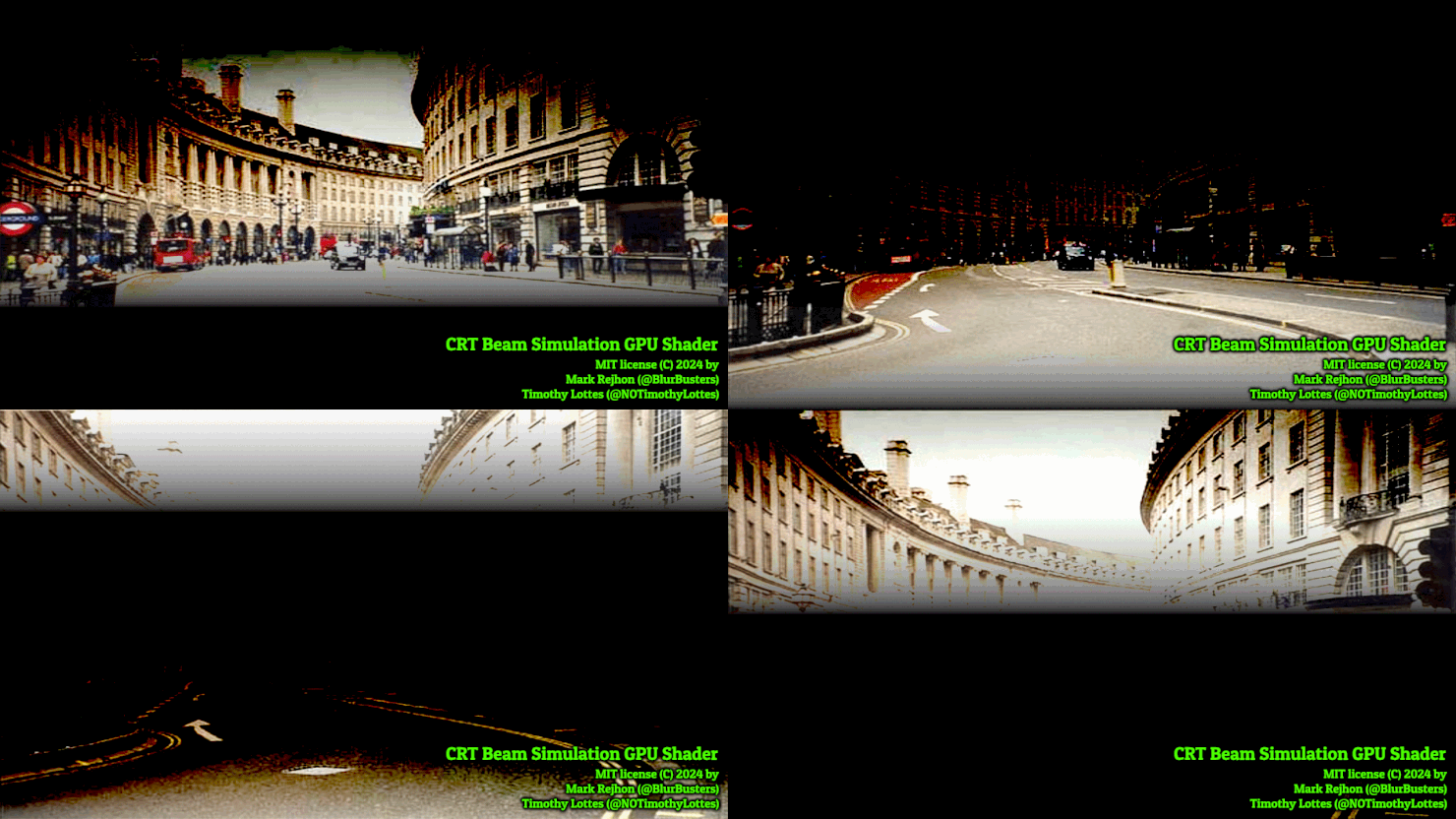
One of the most impactful additions in RetroArch 1.20.0 is the introduction of a revolutionary CRT beam simulation shader. This advanced visual enhancement, a collaborative effort between Mark Rejhon of BlurBusters fame and Timothy Lottes, the esteemed creator of the original FXAA shader and the highly regarded crt-lottes shaders, leverages RetroArch’s recently implemented "subframe" shader capabilities. Its primary objective is to dramatically improve motion clarity on contemporary digital displays, offering a visual experience akin to original Cathode Ray Tube (CRT) monitors without the traditional drawbacks associated with conventional black-frame insertion (BFI) techniques.
For decades, retro gaming enthusiasts have grappled with the challenge of accurately replicating the unique visual characteristics of CRT displays on modern LCD, OLED, and other flat-panel screens. CRTs, with their phosphorescent glow and scanning electron beams, naturally produced smooth motion and vibrant colors that are often lost or distorted on today’s displays. Traditional attempts to mimic this, such as BFI, involve rapidly inserting black frames between game frames to reduce motion blur. While effective to some extent, BFI typically comes with significant compromises: a noticeable reduction in screen brightness, dulled color reproduction, and an increased risk of image persistence – a temporary form of "burn-in" – on many common LCD panel types. This trade-off often forces users to choose between motion clarity and visual quality.
The new CRT beam simulation shader sidesteps these limitations by utilizing RetroArch’s sophisticated "subframe" rendering capabilities. Unlike standard post-processing shaders that operate on fully rendered frames, subframe shaders can intervene at a more granular level, influencing how individual pixels and lines are drawn across multiple sub-frames. This allows for a much more nuanced and accurate simulation of the CRT beam’s behavior, including its refresh cycle, phosphor decay, and interlacing effects. Mark Rejhon, widely recognized for his work at BlurBusters in pushing the boundaries of display technology and motion clarity, brings unparalleled expertise in understanding and optimizing display performance. Timothy Lottes, a pioneer in real-time graphics with his seminal FXAA anti-aliasing technique and highly respected crt-lottes shaders, contributes a deep understanding of shader programming and visual fidelity. Their combined efforts have resulted in a shader that not only enhances motion clarity but does so while preserving the original brightness and color vibrancy of the emulated content. This innovation is particularly significant for fast-paced games, arcade titles, and fighting games, where precise motion perception is crucial for an authentic and competitive experience. The detailed technical underpinnings of this breakthrough are further explored in a dedicated article, providing deeper insights into its operation and implications for display technology.
Bringing Games to Life: Illuminance Sensor Support for Linux
Another groundbreaking feature introduced in RetroArch 1.20.0 is the robust illuminance sensor support specifically for Linux environments. This development, spearheaded by developer Jesse Talavera, unlocks a new dimension of immersion for games that originally integrated ambient light sensors into their gameplay mechanics. The most prominent example is the "Boktai" series on the Game Boy Advance, where players had to physically expose their cartridge to sunlight to power their in-game weapon, the "Gun Del Sol," and progress through the game. Without a physical solar sensor, emulating these titles has always presented a significant challenge, often requiring workarounds or completely bypassing core gameplay elements.
Jesse Talavera’s implementation addresses this long-standing issue by integrating RetroArch with the ambient light sensors commonly found in modern Linux-based devices, such as the popular Steam Deck. A compelling demonstration showcases "Lunar Knights," a spiritual successor to Boktai, running on a Steam Deck, with the game dynamically responding to changes in ambient light as the user adjusts the surrounding illumination. This seamless integration means that players can now experience these unique titles exactly as their creators intended, using real-world light to influence in-game mechanics.
The significance of this feature extends beyond a single game series. It represents a broader effort to faithfully preserve and replicate the entire interactive experience of retro games, including their often quirky and innovative hardware integrations. Many classic consoles and handhelds featured unique peripherals or built-in sensors that added a layer of physicality to gameplay. By enabling illuminance sensor support, RetroArch opens the door for future emulation of other hardware-dependent features. The development team has indicated that the next update for the melonDS DS core will include solar sensor support, further expanding the roster of playable titles that leverage this technology. Furthermore, the roadmap for post-1.20.0 releases includes broader camera support for more platforms, hinting at the potential to emulate games that utilized integrated cameras, such as certain Nintendo DS and PlayStation 2 titles. This continuous pursuit of hardware fidelity in software emulation not only enriches the player experience but also serves as a vital component of digital game preservation, ensuring that the full scope of these interactive artifacts remains accessible and playable for future generations.
RetroArch’s Unwavering Commitment to the User and Open-Source Philosophy
The release of RetroArch 1.20.0 is not merely about new features; it is a testament to the project’s enduring philosophy and its unique sustainability model. Since its inception, RetroArch has been built on the principles of open-source development, community collaboration, and an unwavering focus on the end-user. This commitment is explicitly articulated by the development team, who state that the project "exists for the benefit of our users" and is sustained by "spreading the love to our users." This ethos starkly contrasts with prevalent industry trends where software often comes bundled with aggressive monetization strategies.
In an increasingly commercialized digital landscape, RetroArch distinguishes itself by refusing to "emburden users with in-app ads, monetization SDKs, or paywalled features." This decision is not just a preference; it is a core tenet that shapes the project’s development and relationship with its community. The absence of commercial imperatives allows developers to prioritize innovation, stability, and user experience above all else. This user-centric approach has fostered a loyal and growing community that values the purity of the retro gaming experience.
To sustain its continuous development and ensure the longevity of the project, RetroArch relies entirely on voluntary contributions from its user base. The project actively encourages support through multiple channels, including direct donations, monthly pledges via Patreon, and developer sponsorships on GitHub Sponsors. Additionally, fans can show their support and contribute financially by purchasing official RetroArch merchandise from their Teespring store. This diversified funding model, entirely dependent on community goodwill, highlights the symbiotic relationship between the developers and their users. Every contribution directly fuels research, development, and the implementation of advanced features like the shader subframes and hardware sensor support, ensuring that RetroArch remains at the forefront of emulation technology. This model not only empowers the community but also reinforces the project’s independence, safeguarding its mission to provide a free, comprehensive, and uncompromised retro gaming platform.
Broader Implications and the Future of Emulation
The release of RetroArch 1.20.0 signifies more than just an update; it represents a significant leap forward in the ongoing quest to perfectly replicate and preserve historical video game experiences. The advancements in visual fidelity through subframe shaders and the pioneering hardware integration with illuminance sensors push the boundaries of what is achievable through software emulation. This continuous innovation is crucial for digital game preservation, ensuring that the intricate details and unique interactive elements of classic games are not lost to time or technological obsolescence.
RetroArch, through its Libretro API, has positioned itself as a central hub for various emulation cores, offering a unified and highly customizable platform for hundreds of gaming systems. Its modular design and commitment to open standards have fostered a vibrant ecosystem of developers contributing to different aspects of the project. The introduction of features like the BlurBusters-backed CRT shader not only elevates the aesthetic quality of retro gaming but also underscores the importance of collaborating with external experts to solve complex technical challenges. Similarly, the illuminance sensor support for Linux showcases the project’s dedication to extending immersion beyond mere visual and auditory replication, delving into the realm of tactile and environmental interaction.
The emulation landscape is constantly evolving, facing challenges ranging from hardware advancements to legal complexities. RetroArch’s consistent delivery of high-quality, free, and open-source solutions stands as a beacon for the preservation community. Its innovative approach to funding, rooted in community support rather than commercial exploitation, provides a sustainable model for long-term development. As technology progresses, the demand for authentic retro gaming experiences will only grow, and projects like RetroArch, with their relentless pursuit of perfection in emulation, will be instrumental in meeting that demand. The 1.20.0 update is a powerful reminder that with dedication, expertise, and community backing, the past can be vividly brought to life in the present, offering both nostalgia for veterans and discovery for new generations of gamers. The future promises even more exciting developments, as hinted by upcoming camera support and expanded hardware integrations, solidifying RetroArch’s role as a vanguard in the digital preservation of gaming history.
Changelog 1.20.0
The official changelog for RetroArch 1.20.0, while extensive, highlights numerous other fixes, performance enhancements, and minor feature additions across various cores and platforms. These improvements, though not detailed in the provided excerpt, collectively contribute to a more stable, efficient, and versatile emulation environment. Users are encouraged to consult the full changelog on the RetroArch website for a comprehensive overview of all updates included in this release.