Farhan hamdan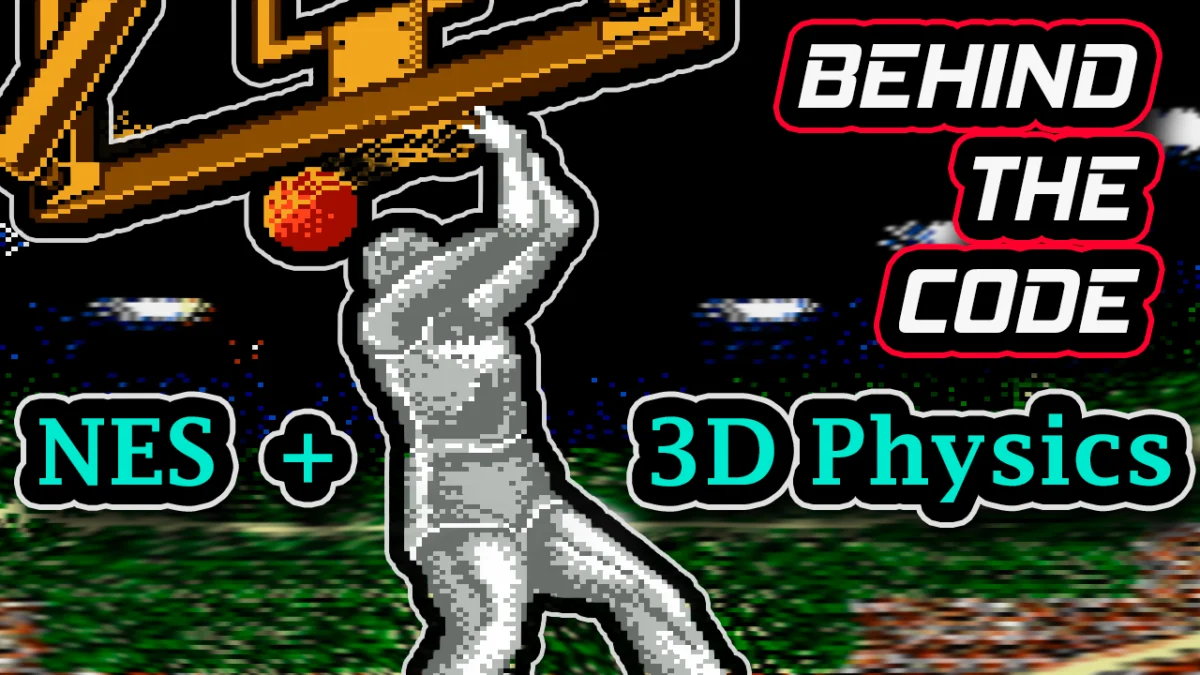
The iconic 1980s NES basketball title, Double Dribble, harbors a secret known to generations of gamers and immortalized in pop culture: a three-point shot from the top-right corner of the court that almost invariably swishes through the net. This seemingly innocuous exploit, famously highlighted in an episode of Family Guy, is far more than a simple glitch; it is a fascinating confluence of early 3D programming ambitions, hardware limitations, and ingenious workarounds characteristic of the 8-bit era. Recent deep dives into the game’s code, notably by platforms like DisplacedGamers, have begun to unravel the complex trigonometry, collision detection quirks, and reliance on lookup tables that collectively give rise to this legendary strategic advantage.
Double Dribble: A Snapshot of 8-Bit Basketball Innovation
Released by Konami first in arcades in 1987 and subsequently ported to the Nintendo Entertainment System (NES) in 1988, Double Dribble carved out a significant niche in the burgeoning console sports genre. At a time when home video game consoles were rapidly evolving, Double Dribble stood out with its then-impressive visual presentation and gameplay mechanics. Unlike many predecessors that presented a static, top-down view of a basketball court, Double Dribble offered a more dynamic, side-scrolling perspective that followed the action, mimicking the feel of a television broadcast. Its most celebrated visual innovation, however, was the inclusion of animated cut-scenes for dunks and three-point shots, momentarily shifting to a close-up, pseudo-3D perspective that offered a sense of immersion previously unseen in console basketball titles. This attempt at presenting a more cinematic and realistic experience, however, came with significant technical challenges for developers working within the strict confines of the NES hardware.
The Nintendo Entertainment System, powered by a Ricoh 2A03 8-bit processor running at approximately 1.79 MHz and a Picture Processing Unit (PPU) capable of displaying 64 sprites and 25 background colors from a palette of 53, was a marvel of its time but inherently limited. It lacked dedicated hardware for floating-point arithmetic, meaning all calculations involving decimals or complex geometry had to be meticulously handled using integer-based mathematics, often through fixed-point arithmetic or, more commonly, pre-calculated data stored in lookup tables. These constraints forced developers to be incredibly creative, often prioritizing visual flair and perceived realism over absolute physical accuracy. For a game aiming to simulate the parabolic trajectory of a basketball in a seemingly three-dimensional space, these limitations were particularly pronounced, laying the groundwork for unforeseen behaviors like the infamous corner three.
The Genesis of the Exploit: Behind the Code’s Ambitions
The secret to Double Dribble‘s corner three lies deep within its programming, a testament to the ingenious, yet sometimes imperfect, solutions employed by 8-bit game developers striving for graphical sophistication. The game’s primary challenge was to simulate the travel of a basketball from a player’s hands to the hoop, accounting for factors like initial velocity, angle, and gravity, all while creating the illusion of depth on a 2D screen.
To achieve this pseudo-3D effect, developers typically manipulate sprite scaling and Y-axis positioning. As the ball travels "deeper" into the screen or "closer" to the viewer, its sprite might scale up or down, and its vertical position on the screen would shift to reflect its perceived height. However, the true complexity emerged in accurately mapping these 2D sprite manipulations to a consistent 3D trajectory.
One of the cornerstone techniques utilized by NES developers to overcome the lack of floating-point math and limited processing power was the extensive use of lookup tables. Instead of calculating complex trigonometric functions (like sine and cosine, essential for parabolic trajectories) in real-time for every frame, developers would pre-compute these values for a range of common angles and store them in memory. When the game needed to determine a ball’s next position, it would simply "look up" the nearest pre-calculated value, significantly saving CPU cycles. While incredibly efficient, this method introduced inherent approximations. The granularity of these tables – how many angles were stored – directly impacted the precision of the calculations. A less granular table meant coarser approximations, potentially leading to noticeable deviations from true physical behavior.
The DisplacedGamers analysis specifically points to how Double Dribble handles ball travel from the shot to the hoop and, crucially, its collision detection. The video reveals that the game’s collision detection at the hoop itself is "bugged." This implies that the logic determining whether a ball successfully passes through the hoop, hits the rim, or misses entirely, contains flaws. Such flaws could manifest in several ways: incorrect bounding box calculations for the hoop, errors in comparing the ball’s position to the hoop’s hit area, or even timing issues in the collision check routine. For instance, a ball might physically pass through the net sprite but be registered as a miss due to a misaligned collision mask, or conversely, a shot that should clank off the rim might be counted as a score.
Pinpointing the Corner Three Anomaly: A Perfect Storm of Code
The infamous corner three exploit is not merely a random fluke; it is the culmination of these technical elements interacting in a specific, predictable manner. When a player positions their character in the top-right corner of the screen and attempts a three-point shot, they trigger a precise set of input conditions that align perfectly with the game’s approximated physics model and its flawed collision detection.

Here’s a breakdown of the likely factors contributing to its consistency:
- Fixed Initial Conditions: Shooting from a fixed, specific screen coordinate means the initial trajectory parameters (starting X, Y, and "Z" depth, as perceived by the game’s internal logic) are always the same. This eliminates variability that might arise from different player positions or movement states.
- Simplified Parabolic Trajectory: The game’s ball physics, while ambitious, likely relies on a simplified parabolic arc derived from those aforementioned lookup tables. For a standard shot, minor variations in player input or environmental factors might cause the ball to deviate slightly, leading to misses. However, from the specific corner, the pre-calculated arc aligns perfectly with the intended "swish" trajectory for that particular set of initial conditions.
- Interaction with Bugged Collision Detection: This is the critical component. The "bugged" collision detection routine, which might misinterpret certain ball positions relative to the hoop, paradoxically works in favor of the corner three. It is plausible that the trajectory generated from the top-right corner, due to its specific angle and velocity, consistently places the ball within a "sweet spot" that the flawed collision detection registers as a successful basket, even if a perfectly accurate physics engine might have registered it as a slight miss or a rim shot. Conversely, trajectories from other parts of the court might hit the rim in a way that the bugged collision detection misinterprets as a miss.
- Absence of Randomness: Many early sports games introduced a degree of randomness to shot success to simulate real-world variability. If Double Dribble lacks significant random factors for shot success when hitting this precise trajectory, then the outcome becomes deterministic.
- Optimized Code Path: It’s also possible that the code path for this specific shot angle and distance was inadvertently more optimized or less prone to numerical errors than others, leading to a more consistent outcome. Developers often focused on making common or visually impressive shots work well, and this particular angle might have fallen into that category by chance.
The consistency of the corner three highlights the inherent challenges of developing complex simulations on constrained hardware. Developers had to make trade-offs between computational accuracy, visual fidelity, and development time. In this case, the pursuit of a dynamic basketball experience led to a system that, while impressive for its era, contained specific vulnerabilities that players would eventually uncover.
A Cultural Phenomenon: From Obscure Exploit to Pop Culture Icon
The discovery of the Double Dribble corner three exploit is a classic tale of early gaming communities. In the pre-internet era, game secrets and glitches spread through playgrounds, word-of-mouth, and dedicated gaming magazines. Players, through countless hours of trial and error, would stumble upon such advantages, solidifying them as shared knowledge among enthusiasts. The corner three became a rite of passage for many Double Dribble players, an almost mythical cheat code that could turn the tide of a game.
Its true ascent into mainstream pop culture, however, came with the 2005 Family Guy episode, "Pawtucket Patriot Ale." In a memorable scene, Peter Griffin and his friends repeatedly exploit the corner three, much to the frustration of their opponent. The episode perfectly captured the essence of the exploit: its simplicity, its almost guaranteed success, and the sheer audacity of leveraging such an obvious flaw. This cultural nod resonated deeply with a generation of gamers who grew up with the NES, instantly recognizing the reference and cementing the corner three’s place in the pantheon of iconic video game glitches. The Family Guy segment introduced the exploit to a much wider audience, ensuring its longevity far beyond the active lifespan of the NES.
Within the retro gaming community, the corner three remains a topic of fascination. It is often discussed in forums, celebrated in "glitch highlight" videos, and occasionally utilized in speedrunning categories or competitive retro gaming events, where its predictable nature can be a strategic asset. The continued analysis of Double Dribble‘s code by enthusiasts like DisplacedGamers underscores the enduring appeal of these classic titles and the desire to understand the technical artistry and accidental quirks that defined them.
Implications and Legacy: More Than Just a Glitch
The Double Dribble corner three exploit, and similar phenomena across early video games, carries several significant implications for game design, player engagement, and the preservation of gaming history.
Firstly, it serves as a stark reminder of the technical limitations faced by developers in the early days of console gaming. Creating immersive, physics-driven experiences on 8-bit hardware required immense creativity and compromises. Glitches like the corner three were often not intentional but rather emergent properties of these complex systems operating at the edge of their capabilities. Modern game development, with vastly superior processing power and sophisticated physics engines, still grapples with bugs, but the nature of those bugs has evolved significantly. The Double Dribble exploit highlights how a small oversight in a lookup table or a collision routine could have a profound, game-altering effect.
Secondly, these exploits often contribute to the unique charm and longevity of retro games. Discovering a secret or mastering a glitch creates a shared experience among players, fostering a sense of community and insider knowledge. It adds an unexpected layer of gameplay, turning a potential flaw into a celebrated feature. For Double Dribble, the corner three became part of its identity, contributing to its enduring appeal and recognition decades after its initial release.
Thirdly, the work of content creators and reverse engineers like DisplacedGamers is invaluable. By delving into the original code, they not only demystify these classic exploits but also shed light on the ingenious programming techniques and design philosophies of a bygone era. This kind of analysis contributes to the historical record of video game development, offering insights into how foundational concepts of game physics, rendering, and interaction were first implemented under severe constraints. It helps preserve the knowledge and context surrounding these influential titles, ensuring that future generations can appreciate the technical challenges and creative solutions that paved the way for modern gaming.
In conclusion, the Double Dribble corner three is far more than just a peculiar glitch. It is a historical artifact, a testament to the ambitious efforts of early game developers pushing the boundaries of 8-bit hardware. It is a lesson in the delicate balance between technical precision and practical implementation, demonstrating how an approximation in one part of the code, combined with a flaw in another, could lead to a highly consistent and exploitable outcome. From its humble origins as a player-discovered trick to its enshrinement in popular culture, the corner three remains a captivating example of how the intricate dance between code, hardware, and human ingenuity can leave an indelible mark on the landscape of video game history.