Farhan hamdan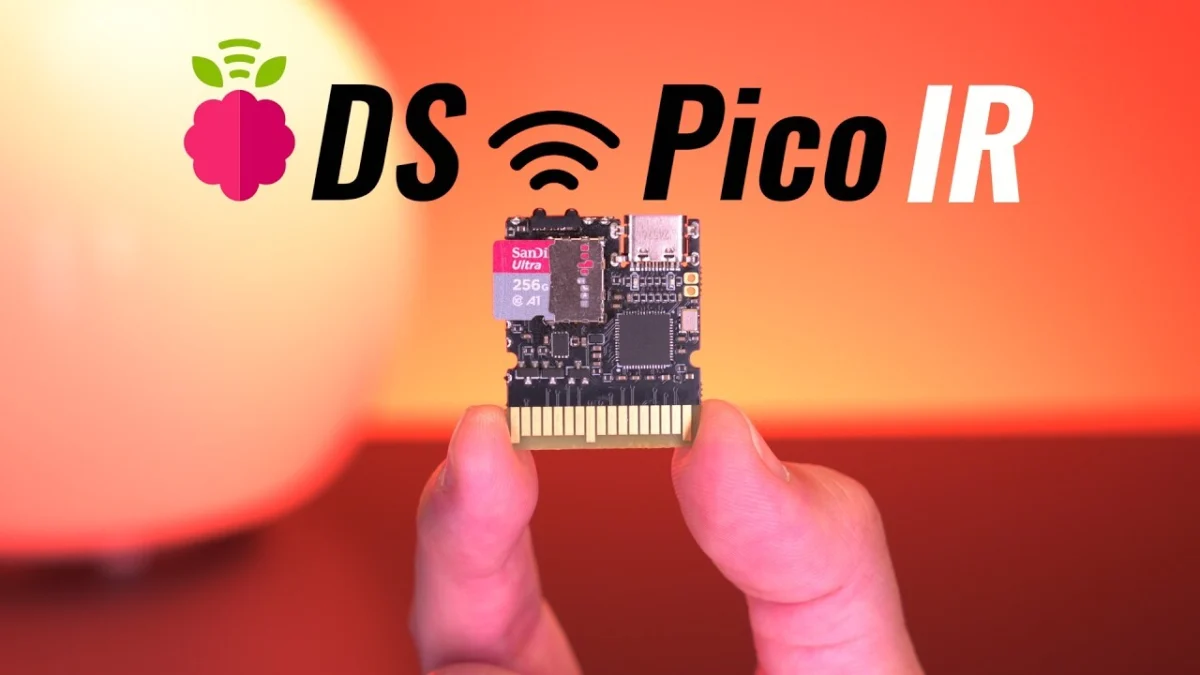
The landscape of retro video game hardware modification has achieved another significant milestone with the release of the DS Pico IR, an advanced iteration of the open-source Raspberry Pi RP2040-powered flash cartridge developed by Phenomods. Recently showcased in-depth by Tito of Macho Nacho Productions, this newly revised hardware brings substantial improvements over its predecessor, most notably native infrared (IR) transceiver capabilities, upgraded onboard RAM, a modern USB-C interface, and support for compressed .ndz ROM files. As the retro gaming community continues to find innovative ways to preserve and enhance legacy hardware, the introduction of the DS Pico IR marks a targeted step forward for enthusiasts of Nintendo’s dual-screen era, particularly fans of the fourth-generation Pokémon titles.
Main Facts and Technical Enhancements
The original DS Pico emerged as a disruptive force in the Nintendo DS flash cartridge market, leveraging accessible microcontroller technology to deliver a reliable, open-source solution for running homebrew applications, software utilities, and backups. The newly launched IR version builds directly upon that foundation by incorporating hardware-level features designed to eliminate long-standing compatibility hurdles associated with authentic accessory integration.
Chief among these upgrades is the integration of an infrared transceiver. This addition bridges a crucial gap for players utilizing titles such as Pokémon HeartGold and SoulSilver, which originally interacted with the physical Pokéwalker accessory included at retail. Previously, flash cart users often faced limitations when attempting to communicate with external infrared peripherals without utilizing original game cartridges. The DS Pico IR resolves this limitation, allowing modern flash cart users to experience authentic connectivity with the pedometer device.
In addition to infrared functionality, the hardware revision includes an upgrade to the internal RAM pool, ensuring smoother execution of resource-heavy homebrew applications and larger ROM files. The transition to a standard USB-C port improves physical durability and aligns the cartridge with contemporary data transfer and power delivery standards. Furthermore, the inclusion of .ndz file format support—utilized in conjunction with the newly launched NDZ Studio utility—allows users to compress Nintendo DS ROMs efficiently, maximizing storage capacity on micro SD cards without sacrificing load speeds or game stability.
Background Context and Evolution of Open-Source Flash Carts
Flash cartridges have played a complex role in the history of portable gaming. Historically commercialized as proprietary devices primarily utilized for running unauthorized software copies, the modern flash cart ecosystem has increasingly pivoted toward homebrew development, hardware preservation, and custom firmware innovation. Devices like the DS Pico series represent a democratization of this technology, shifting production away from closed-source commercial manufacturers and toward collaborative, community-driven hardware design.
The reliance on the Raspberry Pi RP2040 microcontroller in the original DS Pico architecture was a strategic choice by its creators at the LNH Team and Phenomods. By utilizing widely available, low-cost silicon, the project insulated itself against the semiconductor shortages that frequently plague specialized gaming hardware manufacturing. This open-source ethos ensures that documentation, firmware updates, and schematic designs remain transparent and accessible to the public, allowing independent developers to audit, modify, and improve the hardware organically over time.
Chronology of the DS Pico Ecosystem
The development trajectory of the DS Pico platform illustrates the rapid pace at which open-source hardware iterations move compared to traditional consumer electronics.
The initial conception of the DS Pico targeted the core functionality of a functional flash cartridge utilizing the Raspberry Pi RP2040 chip, successfully proving that low-cost microcontrollers could effectively handle the bus timings and data transfer rates required by the Nintendo DS architecture. Distributed through specialized channels such as LaserBear, Phenomods, and AliExpress, the initial release quickly gained traction among hardware modders and homebrew developers.

Following community feedback and technical evaluations by prominent preservationists and content creators, the development team conceptualized a feature-rich variant to address specific community demands. The result was the development of the DS Pico IR.
By the time Macho Nacho Productions published its detailed hardware showcase, manufacturing pipelines had stabilized sufficiently to open regional distribution paths. Pre-orders and backorders were established through primary vendors, including Phenomods for the North American market and Shiraseal for European consumers, accompanied by the web-based NDZ Studio utility to streamline ROM compression for end-users.
Pricing, Availability, and Market Positioning
Priced approximately $10 higher than the baseline DS Pico model, the DS Pico IR occupies a specialized niche within the broader portable flash cartridge marketplace. Industry analysts and community observers note that while traditional commercial flash carts often compete on raw storage compatibility or multimedia features, open-source alternatives like the DS Pico series cater explicitly to enthusiasts who prioritize hardware transparency, longevity, and community-driven support.
Regional distribution has been structured to accommodate international demand, with official supplier pages active across dedicated modding storefronts. The North American rollout is managed directly through Phenomods, while European buyers can acquire the hardware via Shiraseal. Despite the slight price adjustment, the hardware remains cost-competitive against mainstream proprietary flash carts, though its specialized feature set means it is primarily marketed toward dedicated hobbyists rather than casual players.
Analysis of Implications for Preservation and Homebrew
The introduction of the DS Pico IR carries several meaningful implications for the retro gaming and homebrew communities. From a preservation standpoint, the ability to interact with authentic infrared accessories without relying on aging original hardware components ensures that generational gameplay features remain accessible as original cartridges and peripherals degrade over time.
Moreover, the implementation of software compression via the .ndz format addresses a persistent bottleneck in flash cartridge storage management. As the Nintendo DS library contains hundreds of titles ranging from compact puzzle games to expansive role-playing adventures, efficient space utilization directly enhances the user experience. The web-based NDZ Studio application lowers the technical barrier to entry for users wishing to optimize their storage libraries.
However, industry observers point out that the device’s specialized nature limits its mass-market appeal. For standard users who simply require a plug-and-play solution for playing standard game backups, the standard DS Pico or established commercial alternatives may remain sufficient. The IR variant’s primary value proposition is inextricably linked to specific software compatibility, making it a targeted purchase for specific segments of the Pokémon and homebrew communities.
Future Outlook for Open-Source Retro Hardware
As the open-source hardware community continues to mature, projects like the DS Pico IR demonstrate the viability of decentralized, community-engineered gaming accessories. By addressing hardware limitations iteratively based on real-world user feedback, developers are able to produce refined tools that extend the functional lifespan of legacy gaming platforms.
The ongoing evolution of the DS Pico series underscores a broader trend within retro gaming: the shift toward sustainable, repairable, and community-supported alternatives to commercial hardware. Whether future iterations will introduce further connectivity options or expand compatibility with other legacy accessories remains to be seen, but the successful launch of the IR variant confirms that innovation in Nintendo DS hardware development remains robust and active.