Cecilia Chamidah Nur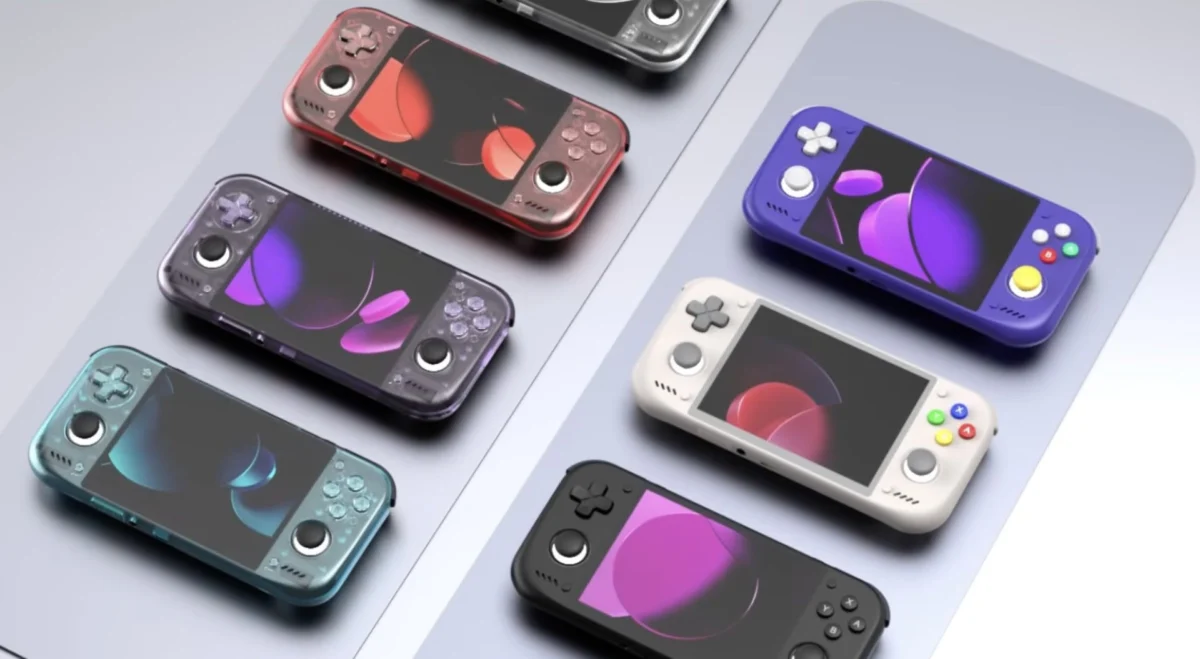
The highly anticipated Retroid Pocket Nova, the latest entry into the burgeoning handheld emulation market, is poised for release with pre-orders scheduled to commence on June 26th or 27th, 2026, depending on global time zones. This new device from Retroid has generated significant interest, not only for its promising specifications and modern design but also for its explicit commitment to a native 4:3 aspect ratio OLED screen, a feature that directly addresses a controversial past incident for the company. The device promises a powerful blend of performance, display quality, and thoughtful design, aiming to solidify Retroid’s position in the competitive Android handheld segment.
The Unveiling and Rapid Information Rollout
Retroid has adopted a swift and engaging strategy for revealing details about the Pocket Nova, transitioning from an initial tease to a comprehensive specification disclosure in a matter of days. This accelerated information rollout has kept the community engaged and anticipatory, contrasting with the longer, more drawn-out reveals often seen in the tech industry.
Initial Tease: June 22nd, 2026
The journey began with a social media announcement on June 22nd, 2026, where Retroid first hinted at the Retroid Pocket Nova. The initial details were sparse but impactful: a "Modern OLED" screen with a 4:3 aspect ratio. Crucially, the company highlighted that this would be their first horizontal 4:3 handheld since the problematic Retroid Pocket Mini. The accompanying image was intentionally obscured, showing only parts of the device and leaving the control panel blacked out, a classic marketing tactic to build suspense. Community speculation quickly arose, with early analysis on platforms like Reddit’s r/SBCGaming suggesting a screen size potentially around 4.4 inches based on the partial image.
First Visuals and Screen Specifications: June 23rd, 2026
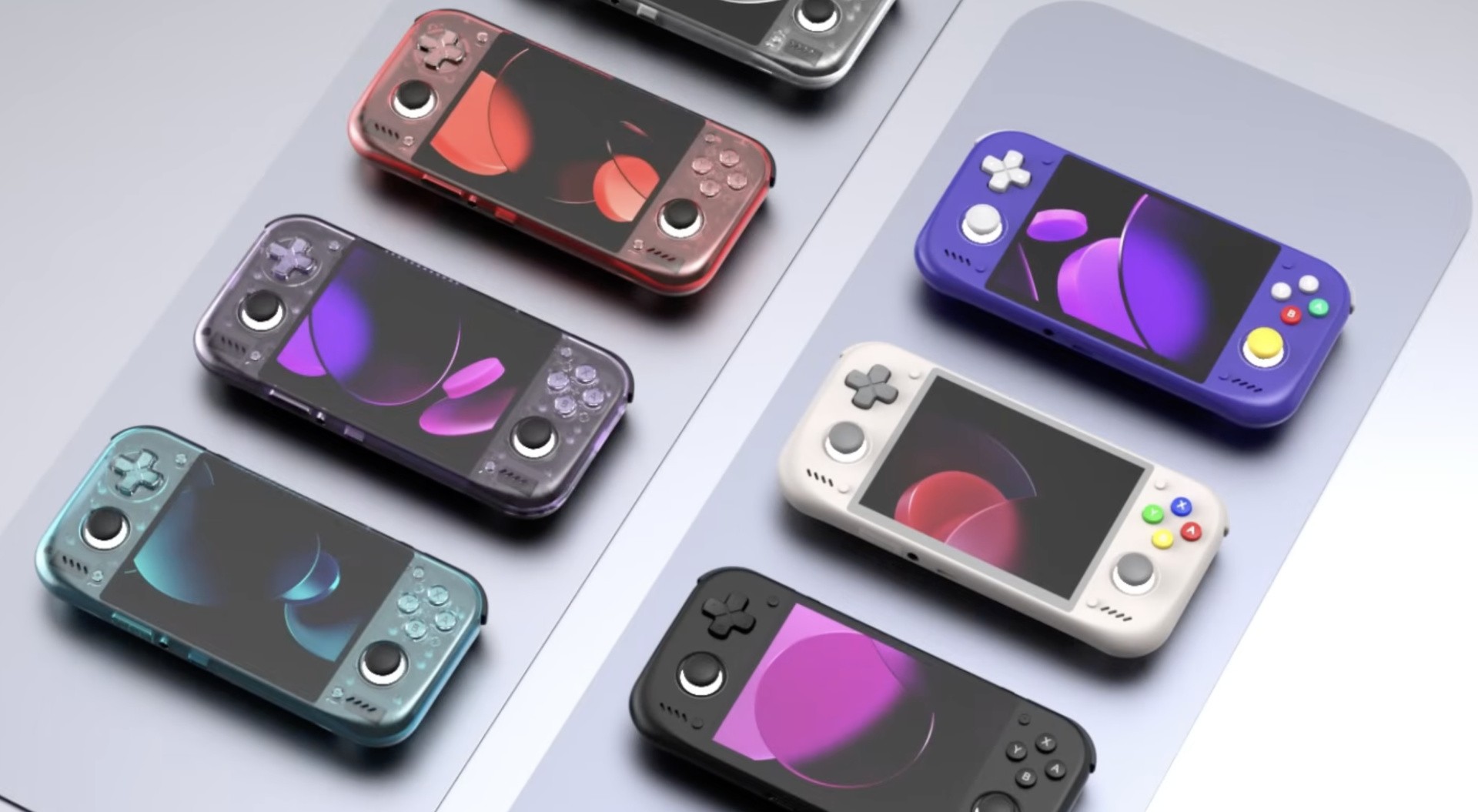
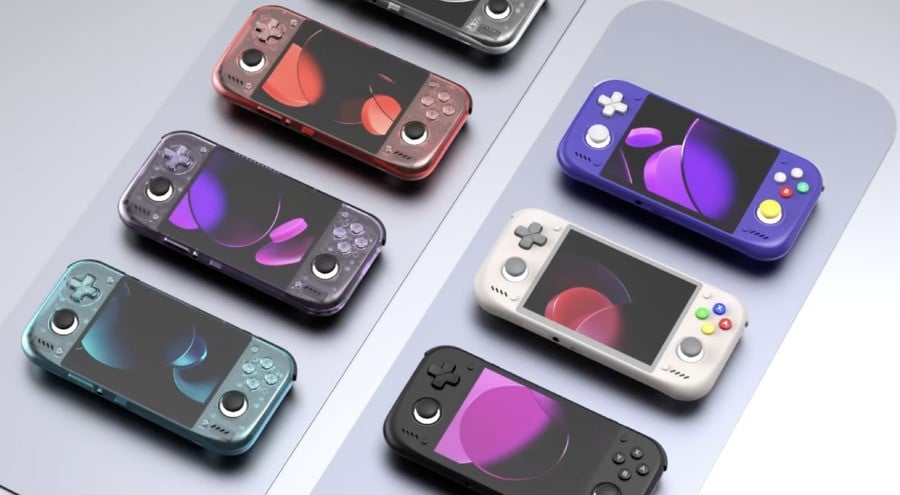
Just one day later, on June 23rd, Retroid released the first clear images of the Pocket Nova, offering a complete view of its physical design. The visuals confirmed a traditional control layout featuring XYAB buttons, a D-Pad, and dual analogue sticks. Notably, the sticks were positioned at the bottom of the device, prompting discussion among enthusiasts about potential ergonomic variations, as previous Retroid models, such as the Pocket 6, offered options for stick placement. Alongside the design reveal, Retroid also confirmed the precise screen specifications: a 4.5-inch AMOLED panel boasting a native resolution of 1280 x 960 pixels and a fluid 120Hz refresh rate. This specific resolution and aspect ratio were immediately recognized as critical for retro gaming fidelity. The company also announced the seven colorways available at launch: Black, 16 Bit, GC, Crystal, Watermelon, Clear Purple, and Ice Blue, providing a wide array of aesthetic choices for consumers.
Full Hardware Specifications and Initial Pricing: June 25th, 2026
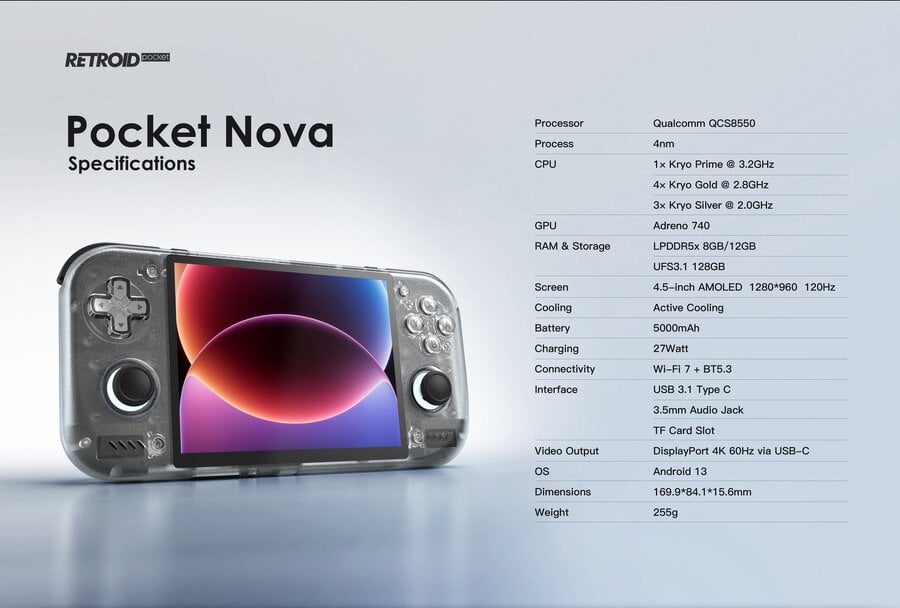
The steady stream of information continued on June 25th, when Retroid officially unveiled the full internal specifications for the Pocket Nova. At the heart of the device lies a Qualcomm QCS8550 processor. This chipset is functionally analogous to the Snapdragon 8 Gen 2, a high-performance system-on-a-chip (SoC) found in flagship smartphones and more premium handhelds like the Retroid Pocket 6, but notably omits the 5G cellular modem. Both are built on a 4nm process node and share identical CPU cores (1× Kryo Prime @ 3.2 GHz, 4× Kryo Gold @ 2.8 GHz, 3× Kryo Silver @ 2.0 GHz), the Adreno 740 GPU, and advanced wireless capabilities including Wi-Fi 7 and Bluetooth 5.3. The QCS8550, typically oriented towards IoT (Internet of Things) applications, is expected to offer a slightly more cost-effective solution for manufacturing due to the absence of the 5G modem, without compromising raw computational power essential for emulation.
Further specifications included Android 13 as the operating system, memory configurations of either 8GB or 12GB of RAM, and up to 128GB of internal storage. Powering the device is a substantial 5000 mAh battery, supported by 27-watt fast charging via USB Type-C. The inclusion of active cooling, a 3.5mm audio jack, and a TF card slot for expandable storage rounded out the comprehensive hardware package. Retroid also provided initial pricing information, detailing various configurations, with the specific price points reflecting the different RAM and storage options.
Pre-Order Details, Video Showcase, and Pricing Adjustments: June 26th, 2026
The latest update, released on June 26th, solidified the pre-order schedule and provided further critical information. Pre-orders are set to go live on Retroid’s official website, with specific timings: June 26th at 9 PM EST for Western audiences, and June 27th at 9 AM BJT for Eastern markets. A significant revelation was the release of the first official video demonstrating the device in action. This video confirmed compatibility with Retroid’s Dual Screen Add-On, an accessory that has been a frequent subject of community inquiries across social media platforms. This feature suggests a modular approach to the Retroid ecosystem, potentially offering enhanced gameplay experiences for certain titles. Additionally, Retroid issued an updated pricing guide. While largely consistent with previous announcements, it introduced an option to purchase the 8GB RAM + 128GB storage configuration in the expanded color palette (Ice Blue, Crystal, Watermelon, Clear Purple) for $234. This adjustment provides greater flexibility for consumers who prefer a specific aesthetic without being restricted to the Black, 16Bit, or GC models for more affordable configurations. The official store page is now live, ready for pre-orders.
Addressing the Past: The Shadow of the Pocket Mini Debacle
The Retroid Pocket Nova’s emphasis on a true 4:3 aspect ratio OLED screen is not merely a technical specification; it represents a significant effort by Retroid to rebuild consumer trust following a past controversy. The "Retroid Pocket Mini debacle," as it became known, cast a long shadow over the company’s reputation and serves as crucial background context for understanding the Nova’s market positioning.
The Retroid Pocket Mini, released prior to the Nova, was marketed as a horizontal handheld with a 4:3 aspect ratio. However, users soon discovered significant screen-scaling issues that proved "unfixable" through software updates. The core problem stemmed from the company’s misleading representation of the Pocket Mini’s native screen resolution. It was revealed that Retroid had not utilized a genuine 4:3 panel but had instead achieved the advertised aspect ratio through a combination of hardware and software trickery, essentially cropping a widescreen panel to simulate a 4:3 display. This deceptive practice led to severe image quality compromises, including non-integer scaling artifacts and black bars, frustrating retro gaming enthusiasts who prioritize pixel-perfect reproduction.
The initial consumer backlash was intense and widespread, particularly across dedicated online communities like r/SBCGaming on Reddit and various YouTube channels. Many felt betrayed by the company’s lack of transparency. Retroid’s initial handling of the situation was met with further criticism, as their responses were perceived as inadequate. However, under sustained pressure, the company eventually conceded to the criticisms, initiating a program for limited refunds and offering replacement screens to affected customers. This was followed by the release of a revised version, the Retroid Pocket Mini V2, which reportedly rectified the screen issues, though it appears to have since been discontinued.
The Pocket Mini incident significantly eroded goodwill and trust among a segment of Retroid’s customer base. For the Retroid Pocket Nova to prominently feature a "Modern OLED" screen with an explicit 4:3 aspect ratio is a direct acknowledgment of this past misstep. It signals a conscious effort by Retroid to demonstrate transparency and a commitment to delivering on advertised specifications, particularly for a feature so critical to the retro gaming experience. This strategic decision is likely intended to reassure consumers that the lessons from the Pocket Mini have been learned and applied to their latest flagship offering.
Under the Hood: A Closer Look at the Nova’s Hardware
The Retroid Pocket Nova’s internal components represent a thoughtful balance of performance, efficiency, and cost-effectiveness, carefully chosen to deliver a robust emulation experience.
Processor Prowess: Qualcomm QCS8550
The decision to incorporate the Qualcomm QCS8550 processor is a key differentiator for the Pocket Nova. While functionally similar to the high-end Snapdragon 8 Gen 2, the QCS8550’s primary distinction is the absence of a 5G cellular modem. This omission is strategic: it likely reduces manufacturing costs, allowing Retroid to offer a powerful chipset at a more competitive price point, which is crucial in the budget-conscious handheld emulation market.
In terms of raw performance, the QCS8550 is formidable. Sharing the same CPU and GPU architecture as the Snapdragon 8 Gen 2 means the Nova is equipped with an Adreno 740 GPU and a potent octa-core Kryo CPU configuration. This hardware is expected to handle a vast array of emulation challenges, from demanding PlayStation 2 and GameCube titles to more recent Switch-era emulation, albeit with varying degrees of optimization and frame rates. The 4nm process node further enhances efficiency, contributing to better battery life and sustained performance under load. For a handheld primarily focused on gaming via Wi-Fi, the absence of 5G is a pragmatic trade-off that should not impact the core user experience while potentially benefiting the final retail price.
Display Excellence: 4.5-inch AMOLED with 120Hz
The display is arguably the Nova’s standout feature. The 4.5-inch AMOLED screen with a 1280×960 resolution and a 120Hz refresh rate is a significant upgrade for the segment. AMOLED technology delivers vibrant colors, infinite contrast ratios with true blacks, and excellent viewing angles, making games visually pop. The 120Hz refresh rate ensures incredibly smooth scrolling and responsive gameplay, a noticeable improvement over standard 60Hz panels, especially in modern Android games or emulated titles that can push higher frame rates.
Crucially, the native 1280×960 resolution combined with the 4:3 aspect ratio is ideal for retro gaming. This resolution allows for perfect integer scaling for many classic console resolutions, such as 2x integer scaling for 640×480 (common for Nintendo 64, Sega Dreamcast, and PlayStation 1) or even 3x integer scaling for 426×320 (SNES). This ensures pixel-perfect rendering without the visual artifacts or blurriness that often plague devices with non-native aspect ratios or resolutions that don’t scale cleanly. After the Pocket Mini’s issues, this dedicated 4:3 OLED is a clear statement of intent regarding retro gaming authenticity.
Power and Endurance: 5000 mAh Battery and Fast Charging
The inclusion of a 5000 mAh battery is substantial for a device of this size and power. Coupled with the efficient 4nm processor and AMOLED screen technology, users can expect extended gaming sessions. The 27-watt fast charging capability via USB Type-C means that downtime between play sessions will be minimized, allowing for quick top-ups. This combination positions the Nova favorably against competitors, offering both longevity and convenience.
Memory, Storage, and Connectivity
The Nova comes with options for 8GB or 12GB of RAM, providing ample memory for Android 13 and demanding emulation tasks. Up to 128GB of internal storage, expandable via a TF card slot, offers plenty of space for game ROMs and Android applications. Active cooling is a welcome addition, ensuring sustained performance during intensive gaming sessions by dissipating heat effectively and preventing thermal throttling. Essential connectivity features include Wi-Fi 7, offering cutting-edge wireless speeds and stability for online gaming and streaming, and Bluetooth 5.3 for seamless peripheral connections. The 3.5mm audio jack caters to users who prefer wired headphones, providing a versatile audio experience.
Design and Ergonomics: A Blend of Form and Function
The Retroid Pocket Nova’s design appears to be a refinement of Retroid’s established aesthetic, prioritizing both visual appeal and comfortable playability. The revealed images showcase a familiar horizontal form factor, which has generally been well-received in the retro handheld community for its ergonomic comfort during extended use.
The control layout features the standard XYAB face buttons, a responsive D-Pad, and dual analogue sticks. While the initial visuals place the analogue sticks at the bottom of the device, mirroring a popular layout for many modern controllers, the precedent set by the Retroid Pocket 6 (which offered interchangeable stick placement) raises questions about potential customization options for the Nova. Such flexibility would cater to a broader range of player preferences and hand sizes. The physical buttons and D-Pad are crucial for precise input in retro games, and Retroid’s track record generally suggests a focus on quality tactile feedback.
The announced seven colorways — Black, 16 Bit, GC, Crystal, Watermelon, Clear Purple, and Ice Blue — offer significant personalization. These range from classic, understated tones to vibrant, translucent options that harken back to popular retro consoles, appealing to different aesthetic tastes. The "16 Bit" and "GC" color schemes, in particular, are often fan favorites, paying homage to iconic gaming eras.
A notable design and ecosystem feature is the confirmed compatibility with Retroid’s Dual Screen Add-On. While details about this accessory’s exact functionality and release are still emerging, its integration with the Nova suggests a modular approach to handheld gaming. This could unlock unique gameplay experiences, particularly for titles that originally utilized dual-screen setups, or offer enhanced productivity for Android applications. It also indicates Retroid’s ambition to build a more comprehensive hardware ecosystem around its core handheld devices.
Market Positioning and Competitive Landscape
The Retroid Pocket Nova enters a vibrant and highly competitive market for Android-based retro handhelds. Its specifications and pricing strategy position it squarely in the upper-mid-range segment, aiming to offer a premium experience without the flagship price tag of devices like the AYN Odin 2 or certain high-end custom Android handhelds.
Retroid has historically carved out a niche by offering devices that strike a balance between performance, build quality, and affordability. The Nova, with its Qualcomm QCS8550 processor, 4.5-inch 120Hz AMOLED 4:3 display, and active cooling, raises the bar for what consumers can expect in this price bracket. It directly competes with offerings from companies like Anbernic, AYN, and Powkiddy, many of which are also iterating on their Android handheld lines.
The Nova’s target audience appears to be discerning retro gaming enthusiasts who prioritize display quality and accurate aspect ratios, alongside robust emulation performance. The explicit 4:3 OLED screen is a powerful selling point for this demographic, differentiating it from many competitors that opt for widescreen displays. The QCS8550 processor ensures strong performance across a wide range of emulators, including more demanding platforms like PlayStation 2, GameCube, and even some early Nintendo Switch titles, making it a versatile option for modern retro gamers.
The initial pricing structure, particularly the $234 option for the 8GB + 128GB configuration in expanded colors, suggests Retroid is aiming for a strong value proposition. By offering a powerful chipset (functionally equivalent to a Snapdragon 8 Gen 2) at a price point significantly lower than devices featuring the actual Snapdragon 8 Gen 2, Retroid seeks to capture a segment of the market looking for high performance without breaking the bank. This aggressive pricing, coupled with the unique display, could make the Nova a compelling choice against rivals that might offer similar performance but with less impressive screens or at higher costs. The integration of the Dual Screen Add-On also hints at a strategy to offer unique accessories and expand the device’s utility beyond standard handheld gaming, potentially creating a distinct ecosystem advantage.
Implications for the Retro Handheld Market
The launch of the Retroid Pocket Nova carries several significant implications for the broader retro handheld market and for Retroid as a company.
Firstly, the Nova’s dedicated 4:3 AMOLED display sets a new benchmark for screen quality and retro authenticity in the mid-range Android handheld segment. By directly addressing the screen-scaling controversy of the Pocket Mini with such a high-quality panel, Retroid is not only rebuilding consumer trust but also pushing other manufacturers to consider native aspect ratios and superior display technologies for their own devices. This could lead to an overall improvement in screen quality across the market, benefiting consumers.
Secondly, Retroid’s choice of the Qualcomm QCS8550 processor could signal a new trend in chipset selection for handheld manufacturers. The QCS series, typically earmarked for IoT applications, offers flagship-level performance at what is likely a more favorable price point due to the absence of cellular modems. This allows companies to deliver powerful emulation capabilities without incurring the higher costs associated with flagship smartphone SoCs. If the Nova proves successful, other manufacturers might explore similar enterprise-grade chipsets as a means to offer high-performance, cost-effective devices.
Thirdly, the rapid-fire information release and the prompt availability of pre-orders reflect a more agile and responsive market strategy from Retroid. This approach, coupled with direct engagement on social media and addressing community feedback (e.g., Dual Screen Add-On compatibility), demonstrates a commitment to transparency and customer focus that is vital in a niche market driven by passionate enthusiasts.
Finally, the Nova’s competitive pricing and robust feature set will undoubtedly intensify competition. It puts pressure on rivals to innovate further, either by matching the Nova’s display quality, offering comparable performance at similar price points, or by differentiating through unique features or form factors. This heightened competition is ultimately beneficial for consumers, driving innovation and offering a wider array of high-quality handheld options.
In conclusion, the Retroid Pocket Nova represents a significant release for Retroid, aiming to restore confidence and push the boundaries of performance and display quality in the Android retro handheld space. With its powerful processor, stunning 4:3 AMOLED screen, and thoughtful design, the Nova is poised to be a compelling option for enthusiasts and a key player in shaping the future trajectory of the portable emulation market. Its pre-order launch marks a pivotal moment for the company, as it seeks to turn a new page and re-establish its reputation for delivering innovative and high-quality gaming devices.